
Quick Summary: Quick Summary: A ploughman’s lunch is the cold British pub plate of sharp cheddar, crusty bread, butter, Branston-style pickle, and pickled onions, with apple, ham, or a hard-boiled egg on the side. I serve it with a mug of strong Builder’s Brew tea. Prep: 10 min | Cook: 0 min | Serves: 2

JUMP TO: Recipe | What is a Ploughman’s Lunch | The History | What to Include | What is Builder’s Brew Tea | How to Make Pickled Onions | More British Recipes | FAQ
At Heathglen Farm, I blend teas for my farmers market stand, and the more I experiment with tea pairings, the more I find myself exploring how other cultures build meals around a cup of tea.
A conversation with a customer about strong black teas led me to Builder’s Brew, the no-nonsense tea of British construction sites. That led me to the Ploughman’s Lunch, a traditional British pub meal that pairs perfectly with a sturdy mug of strong tea.
Here’s what goes into a traditional Ploughman’s Lunch, the surprisingly modern history behind it, and how to brew a proper Builder’s Brew to serve alongside.
This post may contain affiliate links. As an Amazon Associate, I also earn from qualifying purchases. You can read our disclosure information here–
What is a Ploughman’s Lunch?
A Ploughman’s Lunch is a cold meal traditionally served in British pubs, consisting of a range of good quality cheeses (typically an English Cheddar, a Stilton, or a creamy, sweeter cheese like an English Wensleydale. ), crusty bread, butter, pickles, pickled onions, and a range of accompaniments like chutneys or mustards. Cold meats, hard-boiled eggs and apple slices are also classic additions.
A classic Ploughman’s Lunch is not a recipe so much as an assembly. It is a composed plate of complementary flavors and textures meant to be eaten with your hands, ideally with a pint of ale or a strong cup of tea.
Where Did the Ploughman’s Lunch Come From?
The actual name of this type of meal (Ploughman’s Lunch) has disputed origins. The romantic version claims it was the midday meal of agricultural workers (ploughmen) who carried bread, cheese, and pickles into the fields. This image is appealing but more of a myth.
The term itself was actually popularized by the Milk Marketing Board in the late 1950s as a marketing campaign to boost cheese sales in British pubs. The campaign was successful, and the meal became a pub menu staple by the 1960s and 70s.
The meal became enough of a cultural touchstone that a 1983 British film, The Ploughman’s Lunch, used it as a metaphor for invented tradition and historical revisionism.
Regardless of its marketing origins, this is exactly the kind of simple, satisfying meal my family will have for dinner, particularly after a spring planting day when you want something no fuss.
I will often add a Cornish pasty that I get at the local butcher store, just to add something hot and filling to the mix. While a pasty is not a classic part of a Ploughman’s Lunch, it still fits with the British theme and is more filling when having this meal as dinner rather than lunch.
How Is a Ploughman’s Lunch Different from a Charcuterie Board?
In the US, charcuterie boards and cheese platters have become quite popular, and a Ploughman’s Lunch shares many of the same ingredients. Much of the distinction between the two is related to the purpose rather than the ingredients.
Charcuterie boards in the US are primarily seen around the holidays as an option for small to large gatherings of family or guests. The Ploughman’s Lunch originated as portable field food for agricultural workers and evolved into beloved British pub fare.
If you’re hosting a crowd over the holidays, my guide to a holiday cheese and charcuterie board covers how much to buy and how to lay it out.
What Ingredients Go in a Ploughman’s Lunch?
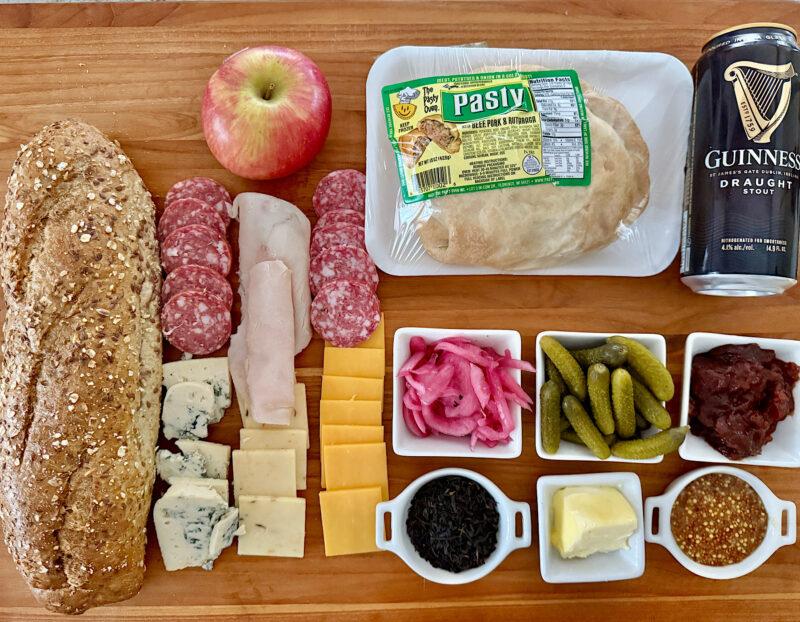
While there is some flexibility as to the exact ingredients to include, most British folk would agree that the items listed below are important, if not critical. I’ve taken the liberty of adding Cornish pasties to make it a full dinner, as meat pies and sausage rolls are often included nowadays.
- Cheeses: Include a mature English Cheddar, a blue cheese like Stilton, and optionally a creamy cheese like Wensleydale or Camembert. The cheese is the centerpiece of the plate.
- Bread: Crusty bread, rolls, or crackers. Nothing soft or pre-sliced.
- Pickles/Relish: A sweet-savory chutney is classic. The British refer to this chutney as a Branston Pickle. Branston Pickle can be hard to find in US grocery stores; I order my Branston pickles from Amazon. Pickled onions are common, as are Cornichon pickles.
- Optional additions: Sliced apple, hard-boiled egg, cold ham or pork pie, celery sticks, cherry tomatoes and a coarse-grained mustard.
- Cornish Pasties: Not traditional to a Ploughman’s but a fitting British addition. I use store-bought for convenience.
- Butter: Real butter, room temperature.
- Drink: Beer or Ale is typical if you are enjoying your lunch in a British pub. An option that fits this sort of lunch is a strong black tea, called a Builder’s Brew.
What Is Builder’s Brew Tea?
Builder’s Brew is strong, unpretentious black tea, the kind served on British construction sites and in working-class cafés. It’s brewed dark, served with milk and usually sugar, in a sturdy mug rather than a delicate teacup.
The name refers to the builders and tradespeople who drink it, providing a strong tea to fuel a long workday. It’s the opposite of a more delicate afternoon tea; it’s functional, bracing, and satisfying.
For my version of a Builder’s Brew, I use a lapsang souchong tea that I sell at my farmers’ markets, as it has a smoky depth that stands up to milk. Any strong black tea works, however. Good options might be English Breakfast, Irish Breakfast, or Assam.
Want to blend your own teas? You won’t find black tea blends here, but it is a great guide for blending herbal teas.
How to Brew Builder’s Brew
- Use more tea than you think (one heaping teaspoon per cup, plus one for the pot)
- Steep 4-5 minutes, which is longer than typical
- Add milk to taste (traditional is a good splash)
- Sugar optional but common
Builder’s Brew is at the opposite end of the tea spectrum from more delicate teas you would find at an afternoon tea service. Where afternoon tea calls for fine china and light steeping, Builder’s Brew wants a thick mug and a long steep.
Both have their place in British culture, but Builder’s Brew is the working tea, meant to fuel you through a long day rather than accompany polite conversation. If you’re interested in how these two traditions differ, I’ve written a guide to afternoon tea vs. high tea that covers the distinctions.
For more on black tea types, steeping times, and caffeine, see my complete guide to tea.
How to Make Quick Pickled Onions
Quick pickled onions are a must on a ploughman’s plate. Their tangy crunch cuts right through rich cheddar, and they’re ready in 30 minutes.
Thinly slice a red onion, pour over a warm brine of vinegar, water, sugar, and salt, and let it sit while you set out everything else. My 30-minute pickled onions recipe has the full method and tips, and the leftovers keep in the fridge for 2 weeks.
Quick Pickled Onion Recipe
Ingredients:
- 2-3 red onions large onions
- 1.5 Teaspoons whole black peppercorns
- 2 Cups vinegar white wine vinegar or apple cider vinegar
- 2 – 3 Tablespoons sugar
- 3 Teaspoons table salt
- water enough to fill jar
Instructions
- Peel the onions and cut them in half. Using a sharp knife or a mandolin, thinly slice the onions and place in a large glass jar (or heat proof bowl) with an airtight cover2-3 red onions
- Add the peppercorns to the jar and lightly shake the jar to disperse the peppercorns1.5 Teaspoons whole black peppercorns
- In a small pot, combine the vinegar, sugar, and salt and heat until sugar and salt are dissolved (couple of minutes). Pour into the jar (or a heat proof bowl) with the onions2 Cups vinegar,2 – 3 Tablespoons sugar,3 Teaspoons table salt
- Fill the jar with water until the water level reaches the top of the onionswater
- Let sit in room temperature for 30 minutes to an hour and place the extra in the refrigerator for later. Serve immediately, or refrigerate in a sealed container for up to 2 weeks.
More British Recipes to Make at Home
- Full English Breakfast
- Casual Afternoon Tea at Home
- Steamed Persimmon Pudding with Hard Sauce
- Jam Tarts
FAQ
Sharp cheddar is most common, but Stilton, Red Leicester, or any British farmhouse cheese works. The key is a cheese with enough flavor to stand up to the pickles.
Cold. It’s an assembled plate, not a cooked meal. The only warm element might be your tea. On my farm we often serve the meal as a dinner and will add a meat pie, sausage roll or meat pasty. Those options are cooked and served warm.
Branston Pickle is a chunky, sweet-tangy chutney made from diced vegetables. It’s a British staple that can be hard to find in US stores; I order mine from Amazon. Pickles are just jarred dill pickles or Cornichons. Pickled onions are whole or sliced red onions preserved in vinegar. Many Ploughman’s plates include all of them.
Yes. Everything except the bread can be prepped ahead. Assemble plates just before serving so the bread doesn’t get soggy.
Absolutely. Beer or ale is the traditional pub pairing. Builder’s Brew tea is an alternative that fits the working-class origins of the meal and works well if you’re serving this for lunch or prefer not to drink alcohol. A strong black tea with milk stands up to the sharp cheese and tangy pickles the same way a good ale does.
Because it’s modeled on what farm laborers, the men who ploughed the fields, carried for their midday meal: bread, cheese, and an onion.
It’s a balanced plate if you go easy on the bread and the pickle, since Branston-style pickle has quite a bit of sugar. Cheese and ham bring protein, and apple and pickled onions add crunch. For low carb, skip the bread and add more cheese, ham, hard-boiled eggs, and celery. Slow carb is trickier, because slow carb rules cut dairy: build the plate around cold ham, hard-boiled or pickled eggs, and pickled onions, and save the cheddar for cheat day. See my slow carb food list for what fits.
It’s the same flavors between two slices of bread: sharp cheddar and Branston-style pickle, often with lettuce, tomato, or onion. It’s a staple of British sandwich shops.
British Ploughman’s Lunch
Equipment
- 1 wooden board for cold cuts and cheeses
Ingredients
- 4-6 oz cheddar cheese
- 1 baguette
- 2 tablespoons butter room temperature
- ¼ cup chutney Branston pickle is traditional chutney
- ½ cup pickled onions see notes
- ¼ cup coarse mustard
- 2 cups black tea see notes for brewing instructions
- 2 Cornish pasties optional
- 1 medium apple optional
- 2 hard boiled eggs optional
- 4 oz sliced ham optional
Instructions
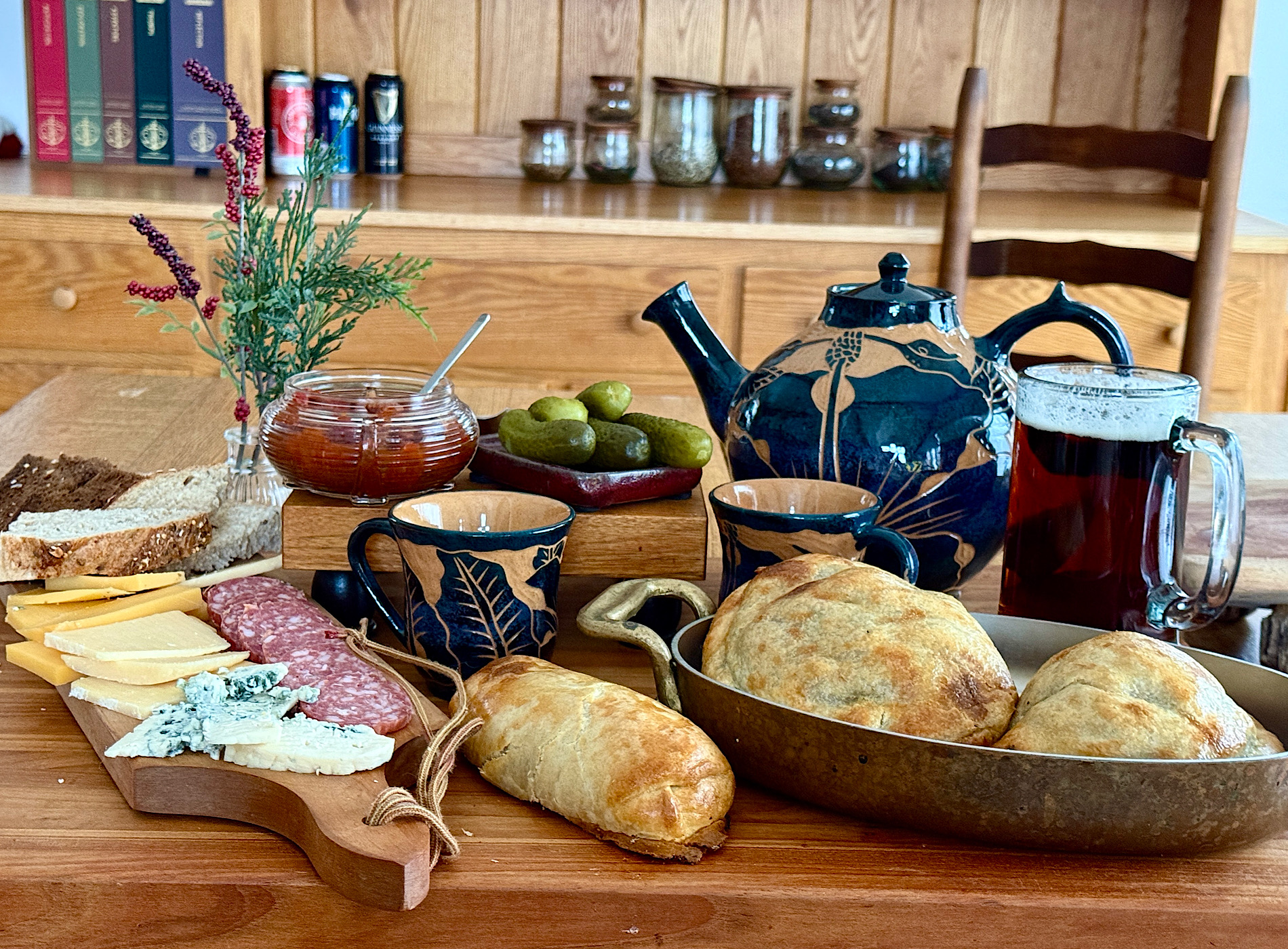
- Arrange cheese, bread, and butter on a wooden board or large plate4-6 oz cheddar cheese, 1 baguette, 2 tablespoons butter
- Add small dishes of chutney and pickled onions and mustard1/4 cup chutney, 1/2 cup pickled onions, 1/4 cup coarse mustard
- Add the apple, eggs, ham, and warm pasties if using. Heat store-bought pasties according to the package2 Cornish pasties, 1 medium apple, 2 hard boiled eggs, 4 oz sliced ham
- Serve with Builder’s Brew tea2 cups black tea
Notes
- For quick pickled onions: Slice 1 red onion thinly. Combine 1/2 cup vinegar, 1/2 cup water, 1 Tbsp sugar, 1 tsp salt. Pour over onions, let sit 30 minutes. Full recipe
- For Builder’s Brew: Use strong black tea (English Breakfast, Assam, or lapsang souchong), steep 4-5 minutes, add milk to taste
- Nutrition doesn’t include the optional pasties.