
Quick Summary: Fresh fruit transforms ordinary iced tea into something beautiful and delicious. Add sliced strawberries, muddled blueberries, or a handful of raspberries to your tea for natural sweetness and flavor. Two methods work well: cold brew overnight for the smoothest result, or hot brew and chill for same-day drinking. Both are simple, and neither requires special equipment beyond a pitcher that fits in your fridge.
Jump to: RECIPE | Equipment | Cold Brew Method | Hot Brew Method | Flavor Pairings | Tips | Tea Syrups | FAQ
Although I grow blueberries as a specialty crop at HeathGlen Farm (600 plants) and sell the blueberries at the farmers market, I also grow strawberries, raspberries, blackberries, and currants for personal use.
Every summer, I use the berries to make cool, refreshing drinks. Sometimes it is just fruit-infused water, sometimes simple syrups for Italian sodas, but most often it’s for simple iced teas.
The concept is simple: add fresh fruit to tea, let it steep, and drink something that looks as good as it tastes. The fruit releases its flavor and color into the tea, creating a drink that’s naturally sweet (or close to it) without needing much added sugar.
Americans drink more iced tea than the rest of the world combined, but most of us buy it ready-made rather than brewing it at home. I think that’s partly because iced tea seems complicated, as in big batches, special equipment, waiting overnight. It doesn’t have to be.
This guide keeps it simple. Two methods, flexible fruit pairings, and a recipe you can scale to whatever fits in your refrigerator.
Equipment: Keep It Simple
You don’t need much, but one thing does matter:, which is a pitcher that fits in your fridge.
I learned this the hard way. I ordered a beautiful glass pitcher with a strainer lid from Amazon, perfect for brewing and pouring without loose tea or fruit bits getting in the glass. It arrived, I filled it with tea, and it was too tall to fit on any shelf in my refrigerator!
Now I just take the tall pitcher to market and use it to give out samples, but my husband is quite distressed as he is the iced tea enthusiast and there’s none for him.
What to look for:
- Measure your fridge first. Measure the height of your tallest shelf space before ordering anything.
- A lid is important. It keeps the tea fresh and prevents fridge odors from seeping in.
- A strainer lid is convenient for keeping fruit and tea leaves out of your glass, but you can also just pour through a strainer, discard the fruit and leaves and put the pitcher back in the fridge.
- Glass or BPA-free plastic both work. Glass looks better in my opinion. We’re trying to remove anything in our house that might include microplastics. It is heavier however so factor that in your purchase.
Size considerations:
If fridge space is tight, make smaller batches. A half-gallon (8 cups) is plenty for one or two people and takes up less room than a full gallon. You can also use a large mason jar or any container with a lid.
What I use:
I have recently purchased this 2-liter glass pitcher and so far, I love it. I bought it because the lid is not plastic and it has a fine hole strainer but also a large hole strainer.
If you are infusing with leafy herbs, they can be a problem with the fine holes, making it pour extremely slowly. Sometimes however the fine mesh holes are great if you want to strain out the small particles and have a really clear tea.
It fits on my fridge shelf, makes enough for a few days, and I strain as I pour.
Two Methods: Choose Your Timeline
Both methods work well. Choose based on when you want to drink it.
Method 1: Cold Brew Overnight (Smoothest Flavor)
Cold brewing extracts sweetness without bitterness. The low temperature pulls flavor gently from both the tea and the fruit. This is my preferred method when I think ahead.
Timeline: 8-12 hours (overnight)
Basic ratio for 2 quarts (8 cups):
- 4-5 tablespoons loose leaf tea (or 6-8 tea bags)
- 1-2 cups sliced or muddled fresh fruit
- 8 cups cold water
- Fresh herbs if desired (a few sprigs of mint, basil, etc.)
Process:
- Add tea to pitcher
- Add sliced fruit (slice strawberries, lightly crush blueberries or raspberries to release juice)
- Add herbs if using
- Pour cold water over everything
- Cover and refrigerate 8-12 hours or overnight
- Strain out tea leaves and fruit (or leave fruit in for beauty if serving immediately)
- Serve over ice
Notes:
- Black tea and green tea both cold brew beautifully
- Herbal teas need the full 12 hours to develop flavor
- The fruit will look tired after steeping — strain it out and add fresh fruit for serving if presentation matters
- Keeps refrigerated 3-4 days
Method 2: Hot Brew and Chill (Same-Day Drinking)
When you want fruit-infused iced tea today and didn’t plan ahead, this method works. You brew a concentrated hot tea, add fruit, and chill quickly.
Timeline: About 1 hour
Basic ratio for 2 quarts (8 cups):
- 4-5 tablespoons loose leaf tea (or 6-8 tea bags)
- 4 cups hot water (appropriate temperature for your tea type)
- 1-2 cups sliced or muddled fresh fruit
- 4 cups cold water or ice
- Fresh herbs if desired
Process:
- Brew tea in 4 cups of hot water at the right temperature (boiling for black tea, 175°F for green tea, boiling for herbal)
- Steep for normal time (4-5 minutes for black, 2-3 minutes for green, 5-7 minutes for herbal)
- Strain out tea leaves immediately (don’t oversteep — this causes bitterness)
- Add sliced or muddled fruit to the hot tea
- Let fruit steep in the hot tea for 10-15 minutes
- Strain out fruit
- Add 4 cups cold water or pour over ice to cool quickly
- Refrigerate until cold, or serve immediately over ice
Notes:
- The hot tea extracts fruit flavor quickly
- Cooling with ice dilutes slightly — account for this or use cold water
- Tastes more robust than cold brew, which some people prefer
- Make same day or the night before
Flavor Pairings: What Works Together
Not all fruit-tea-herb combinations work equally well. Here are pairings I’ve tested with fruit from my farm:
Strawberry
| Tea Base | Herb Addition | Notes |
|---|---|---|
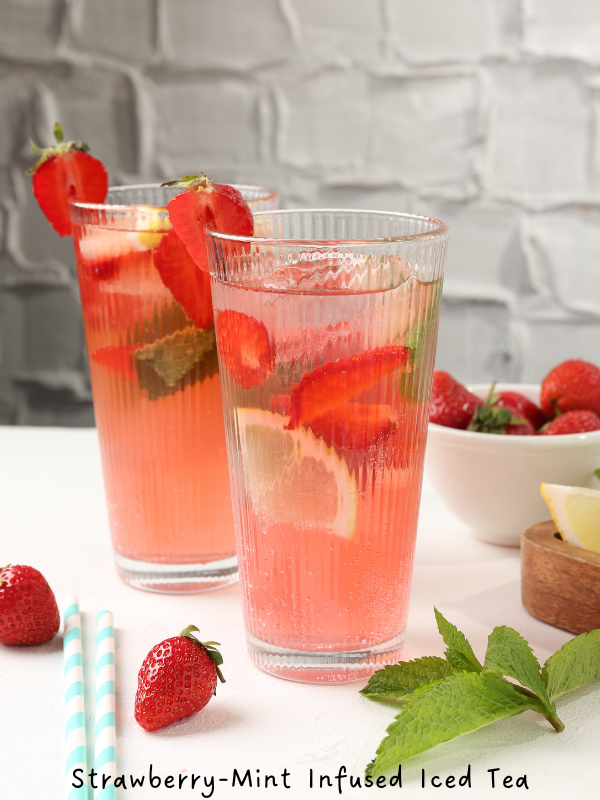
| Green tea | Mint | Bright, fresh, classic (recipe below) |
| Black tea | Basil | Unexpected but lovely |
| White tea | None or lemon verbena | Delicate, let the strawberry shine |
| Hibiscus | Mint | Very tart, very pink |
Blueberry
| Tea Base | Herb Addition | Notes |
|---|---|---|
| Black tea | Lavender (light hand) | Sophisticated, floral |
| Green tea | Mint | Clean and refreshing |
| Rooibos | Cinnamon stick | Warm-spiced, caffeine-free |
| White tea | Lemon peel | Subtle and elegan |
Raspberry
| Black tea | None or rose petals | Tart and bold |
| Hibiscus | Mint | Very tart, deep red |
| Green tea | Lime zest | Bright and zingy |
| Rooibos | Vanilla (bean or extract) | Sweet and mellow |
Blackberry
| Tea Base | Herb Addition | Notes |
|---|---|---|
| Black tea | Sage (just a leaf or two) | Earthy and complex |
| Oolong | None | Let the tea complexity show |
| Hibiscus | Ginger | Tart with warmth |
| Mint herbal | Lime | Refreshing, caffeine-free |
Currant (Red or Black)
| Tea Base | Herb Addition | Notes |
|---|---|---|
| Black tea | None | Classic, British-style |
| Green tea | Mint | Tart and bright |
| Hibiscus | Orange peel | Deep color, citrus notes |
| Rooibos | Cinnamon | Warming, caffeine-free |
General Principles:
- Tart fruits (currants, raspberries, hibiscus) pair well with sweeter or earthier teas
- Sweet fruits (strawberries, ripe blueberries) work with lighter teas that won’t overpower them
- Mint works with almost everything. It’s a safe choice when experimenting
- Go light on strong herbs (lavender, rosemary, sage). A little goes a long way
- Citrus zest adds brightness without adding liquid or changing sweetness
Tips for Best Results
- Slice or muddle the fruit. Whole berries look pretty but don’t release much flavor. Slice strawberries, lightly crush blueberries and raspberries with a fork or muddler. You want the juice to escape.
- Taste before sweetening. Fruit adds natural sweetness, especially in cold brew. Taste your tea before adding sugar or syrup. You may not need it, or need less than usual.
- If you do sweeten, use simple syrup. Granulated sugar doesn’t dissolve well in cold liquid. Simple syrup (equal parts sugar and water, heated until dissolved, then cooled) mixes in smoothly. Or add sugar while the tea is still warm in the hot brew method.
- Fresh fruit for presentation, steeped fruit for flavor. The fruit that steeps overnight looks tired — it’s given its flavor to the tea. If you’re serving to guests and want it to look beautiful, strain out the steeped fruit and add fresh slices to the pitcher or glasses.
- Adjust strength to your taste. More tea = stronger flavor. More fruit = more fruit-forward. More water or ice = lighter drink. These ratios are starting points. Make it how you like it.
- Scale down if fridge space is tight. A quart jar of iced tea is enough for a day or two. You don’t need to make a gallon at a time.
On Tea Syrups
If you want to streamline the process even further, flavored simple syrups are another approach. A syrup made with mint, lavender, cinnamon-vanilla, or fruit can be stored in the fridge and added to plain iced tea by the glass.
I make a cinnamon-vanilla syrup that pairs beautifully with iced black tea. A splash in a glass transforms basic tea into something special. I use it frequently for iced tea, but also to make a great homemade Italian soda or to use in a DIY London Fog.
Here is a recipe if you’d like to make your own Cinnamon-vanilla syrup. The advantage of syrups is they keep longer than fresh fruit and let you flavor tea by the glass rather than by the pitcher.
For more on making your own syrups for all kinds of beverages (cocktails or mocktails), see my post on homemade fruit simple syrups or shrub syrups.
FAQ
Yes. Frozen fruit actually works well because it’s often picked riper and the freezing breaks down cell walls, releasing juice more easily. No need to thaw — add it frozen. It will chill your tea as it steeps.
You can, but it needs longer to rehydrate and release flavor. Dried fruit works better in cold brew (full 12 hours) than the quick method. The flavor is more concentrated and less “fresh” tasting.
Any mint works. Spearmint is classic and bright. Peppermint is more intense. Chocolate mint (my favorite) adds subtle depth. Use what you have or what you grow.
3-4 days refrigerated. The fruit flavor fades over time, and the steeped fruit can start to break down. Make smaller batches if you won’t drink it quickly.
The fruit has given most of its flavor to the first batch. You can try, but the second batch will be much weaker. Better to compost the spent fruit and use fresh.
Green tea especially turns bitter if steeped too long or in water that’s too hot. Follow steeping times carefully, and remove the tea leaves promptly. Cold brew is more forgiving because the low temperature doesn’t extract as many tannins.
Yes. Use about 1.5 times as many bags as you would tablespoons of loose tea. So if a recipe calls for 4 tablespoons loose tea, use 6 tea bags.
Black tea is robust and holds up well to bold fruits. Green tea is lighter and pairs with delicate fruits like strawberry. Herbal teas (especially hibiscus and rooibos) are caffeine-free and blend beautifully with fruit. There’s no wrong answer…just experiment with what you have.
Further Reading:
For more on brewing methods, see my post on big batch iced tea methods.
If you want to explore the world of teas and tisanes, check out this Complete Guide to Teas. It includes information on how to grow a tea garden, types of tea, brewing times and temp., recipes for blends, caffeine amounts, and much more.
Strawberry Mint Iced Tea
Equipment
- hot water kettle
- teapot if making hot brew
Ingredients
- 4-6 tablespoons loose leaf green tea or 6-8 green tea bags
- 1 cup fresh strawberries hulled and sliced
- 8-10 fresh mint leaves plus more for serving
- 8 cups water
- Honey or simple syrup to taste optional
- Ice for serving
Instructions
Cold Brew Method
- Add green tea, sliced strawberries, and mint leaves to a 2-quart pitcher.4-6 tablespoons loose leaf green tea, 1 cup fresh strawberries, 8-10 fresh mint leaves
- Pour 8 cups cold water over everything.8 cups water
- Cover and refrigerate 8-12 hours or overnight.
- Strain through a fine mesh strainer into a clean pitcher or directly into glasses.
- Taste and add honey or simple syrup if desired.Honey or simple syrup to taste
- Serve over ice, garnished with fresh mint and a strawberry slice.
Hot Brew Method:
- Bring 4 cups of water to 175°F (just before boiling — small bubbles forming but not rolling).
- Add green tea and steep for 2-3 minutes. Don’t oversteep or it will be bitter.4-6 tablespoons loose leaf green tea
- Strain out tea leaves immediately.
- Add sliced strawberries and mint leaves to the hot tea.1 cup fresh strawberries, 8-10 fresh mint leaves
- Let steep 10-15 minutes.
- Strain out fruit and mint.
- Add 4 cups cold water and pour over ice to cool.
- Taste and add honey or simple syrup if desired.
- Refrigerate until cold, or serve immediately over ice.Ice for serving
- Garnish with fresh mint and a strawberry slice.