Quick Summary: Red clover, black cohosh, vitex (chasteberry), and red raspberry leaf have the most traditional use and research support for hormonal symptoms. They work through different mechanisms and address different life stages. These herbs can help manage symptoms, but hormonal health is complex and tea alone won’t solve significant issues.
Jump to: Understanding Hormonal Tea | Best Herbs for PMS | Best Herbs for Perimenopause and Menopause | Herbs to Avoid | How to Use | Blending Recipes | References | FAQ

Hormonal shifts are part of life as a woman, from the monthly cycle to the years-long transition of menopause. The symptoms that come with these shifts, cramps, mood swings, hot flashes, sleep disruption, range from mildly annoying to significantly life-altering.
Herbal support for women’s hormonal health has existed for as long as women have been gathering plants. Raspberry leaf for menstrual support. Black cohosh for hot flashes. Vitex for irregular cycles. These weren’t random discoveries. Women noticed what worked and passed that knowledge forward.
Modern research has begun to validate some of these traditional uses, though the evidence is often mixed. Hormones are complicated, and individual responses vary widely. What helps one woman may do nothing for another.
This post covers what we actually know about hormonal herbs, what remains uncertain, and how to approach these teas thoughtfully. I’m not a healthcare provider, and significant hormonal issues deserve professional attention. But for many women, certain teas can be useful tools for symptom management.
Understanding How Hormonal Teas Work
Before diving into specific herbs, it helps to understand the different mechanisms at play.
Phytoestrogens
These are plant compounds that weakly mimic estrogen in the body. Red clover and soy are high in phytoestrogens called isoflavones. The theory is that these plant estrogens can help buffer hormonal fluctuations, providing mild estrogenic activity when your own estrogen is low (menopause) or competing with stronger estrogens when levels are high.
The research on phytoestrogens is quite mixed. Some studies show benefit for menopausal symptoms, and others show no effect. Individual response seems to depend on factors like gut bacteria (which help metabolize phytoestrogens), baseline hormone levels, and genetics.
Hormone modulators
Modulators like vitex (an herbal supplement) don’t contain phytoestrogens but rather they appear to influence how your body produces and regulates its own hormones, particularly through effects on the pituitary gland.
Symptom relievers
This would include herbs like chamomile and peppermint, which don’t directly affect hormones but help manage symptoms like cramping, sleep disruption, and mood changes that accompany hormonal shifts.
Adaptogens
Adaptogens like ashwagandha help the body cope with stress, which matters because stress hormones directly affect reproductive hormones. High cortisol (which often accompanies stress) can worsen PMS, disrupt cycles, and intensify menopausal symptoms.
Best Herbs for PMS and Menstrual Support
Red Raspberry Leaf (Rubus idaeus)
Raspberry leaf is the classic uterine tonic, traditionally used to tone and strengthen the uterus. It’s rich in minerals including iron, calcium, and magnesium, which many women are low in, especially during menstruation.
Women use raspberry leaf for menstrual cramps, heavy periods, and general reproductive health. It’s also traditionally used during pregnancy to prepare for labor, though you should discuss this with your midwife or doctor.
What the research says: There are limited formal studies, but there is a long history of safe traditional use. The toning effect may help reduce cramping by supporting more coordinated uterine contractions.
Flavor profile: Mild, slightly tannic, similar to black tea but gentler. Easy to drink daily.
Vitex / Chasteberry (Vitex agnus-castus)
Vitex (an herbal supplement) works on the pituitary gland, influencing the production of luteinizing hormone and prolactin. This makes it useful for PMS symptoms, particularly breast tenderness, mood swings, and irregular cycles.
Studies show vitex can reduce PMS symptoms, though it typically takes 2 to 3 months of consistent use before effects are noticeable. It’s not a quick fix.
Important note: Vitex influences hormone production, so it’s not appropriate for everyone. Avoid if you’re on hormonal birth control, hormone therapy, or have hormone-sensitive conditions. Consult a healthcare provider before using.
Flavor profile: Peppery, slightly bitter. Usually taken as a tincture or capsule rather than tea.
Cramp Bark (Viburnum opulus)
The name says it all. Cramp bark is an antispasmodic that relaxes smooth muscle, including uterine muscle. It’s one of the most effective herbs for menstrual cramps.
How to use: Works best when taken at the first sign of cramps or even a day before your period typically starts. Often combined with ginger for enhanced effect.
Flavor profile: Bitter, earthy. More palatable as a tincture than tea.
Ginger
Ginger reduces prostaglandins, the compounds responsible for menstrual cramps and inflammation. Studies show ginger can be as effective as ibuprofen for menstrual pain when taken during the first few days of menstruation.
How to use: Fresh ginger tea, several cups daily during menstruation. Start when cramps begin or just before your period.
Flavor profile: Warm, spicy, pleasant.
Chamomile
Chamomile’s antispasmodic and calming properties make it useful for menstrual cramps and the mood symptoms of PMS. Studies show chamomile can reduce both physical and psychological PMS symptoms.
A warm cup of chamomile during your period addresses cramping, promotes relaxation, and helps with the sleep disruption that often accompanies menstruation.
Best Herbs for Perimenopause and Menopause
The “transition years” bring their own set of challenges. Menopause can express itself as hot flashes, night sweats, sleep disruption, mood changes, vaginal dryness, and the general disorientation of a body doing something new.
It can definitely impact your quality of life for quite a long time for some women.
Black Cohosh (Actaea racemosa)
Black cohosh is the most studied herb for menopausal symptoms, particularly hot flashes. It’s been used by Native American women for centuries and has modest research support for reducing the frequency and intensity of hot flashes.
How it works isn’t entirely clear. It was once thought to be phytoestrogenic, but current research suggests it may work on serotonin receptors or other non-hormonal pathways.
What the research says: Results are mixed. Some studies show significant reduction in hot flashes; others show no difference from placebo. Women who respond tend to respond well; those who don’t may need other approaches.
Cautions: Rare reports of liver problems, though causation isn’t established. Avoid if you have liver disease. Not recommended during pregnancy or breastfeeding. There are some concerns about use with hormone-sensitive cancers, so using it should definitely be discussed with your oncologist.
Flavor profile: Bitter, not pleasant as a tea. Usually taken as capsules or tincture.
Red Clover (Trifolium pratense)
Red clover is rich in isoflavones, phytoestrogens that may help buffer the estrogen decline of menopause. Studies suggest it can reduce hot flashes and may support bone health and cardiovascular health during menopause.
What the research says: Modestly positive for hot flashes in some studies, no effect in others. May take 4 to 12 weeks of consistent use to see benefits. Individual response varies significantly.
Flavor profile: Mild, slightly sweet, grassy. Pleasant as a tea.
Caution: Because red clover is estrogenic, women with hormone-sensitive conditions (breast cancer, endometriosis, fibroids) should consult their healthcare provider before using.
Sage (Salvia officinalis)
Sage has traditionally been used for excessive sweating and hot flashes. Small studies suggest it can reduce the frequency and intensity of hot flashes, possibly by affecting estrogen receptors or the sweat-regulating centers in the brain.
How to use: Tea made from dried sage leaves, 1 to 2 cups daily. Effects may be noticed within a few weeks.
Flavor profile: Savory, herbaceous, the same sage you use in cooking. Some people enjoy it; others find it too culinary for a beverage.
Caution: High doses of sage over long periods aren’t recommended. Avoid during pregnancy. Can affect blood sugar levels.
Licorice Root
Licorice contains compounds that mimic estrogen and may help with hot flashes and vaginal dryness. It also supports adrenal function, which matters during menopause when adrenal glands take over some estrogen production.
Caution: Licorice raises blood pressure and depletes potassium with regular use. Not appropriate for women with hypertension, heart disease, or kidney problems. Short-term use only, and not more than 1 to 2 cups daily.
Flavor profile: Naturally sweet, pleasant in blends.
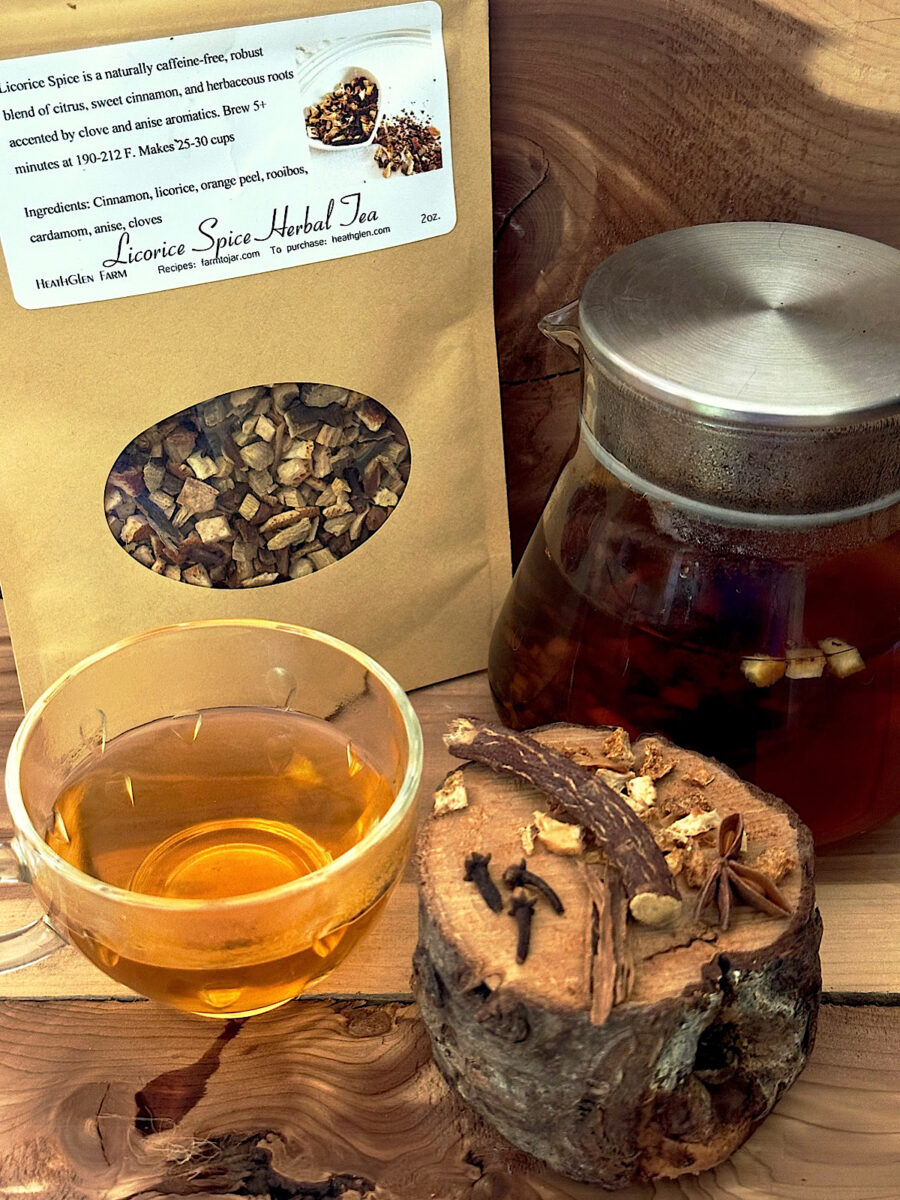
I make a blended herbal tea for my market with licorice root, cinnamon, orange peel, rooibos, cardamom, anise, and cloves. Customers that say they don’t like licorice enjoy this blend, as the flavor of licorice root is much milder than other forms of licorice. It makes a great iced tea also, as it is sweet enough on it’s own without needing added sugar.
Ashwagandha
Ashwagandha is an adaptogen that helps the body manage stress. During perimenopause and menopause, when cortisol can exacerbate symptoms like sleep disruption, mood swings, and hot flashes, ashwagandha may help restore balance.
Small studies in perimenopausal women show ashwagandha can help with hot flashes, sleep, and mood. It works gradually over weeks of consistent use.
Caution: Not recommended during pregnancy or breastfeeding. May interact with thyroid medications.
Flavor profile: Earthy, slightly bitter, best blended with other herbs or as golden milk.
Supporting Herbs for Any Hormonal Stage
These herbs don’t directly affect hormones but help manage symptoms that accompany hormonal changes.
- Valerian and Passionflower: For sleep disruption, which worsens during PMS and menopause. See my post on teas for sleep.
- Lemon Balm: Calming and mood-supporting, helpful for anxiety and irritability that accompany hormonal shifts.
- Peppermint: Cooling, which some women find helpful for hot flashes. Also good for the digestive upset that sometimes accompanies PMS.
- St. John’s Wort: Has evidence for mild depression, which can accompany perimenopause. However, it interacts with many medications including birth control pills, so use with caution and professional guidance.
- Dong Quai: Traditional Chinese herb for women’s health. Research is mixed, and most studies show benefit only when dong quai is combined with other herbs. Sometimes called “female ginseng.”
For sleep disruption during hormonal changes, see my post on teas for sleep.
Herbs to Approach with Caution
Avoid anything estrogenic if you have hormone-sensitive conditions. Red clover, black cohosh, dong quai, licorice, and soy all have estrogenic effects. If you have or have had breast cancer, endometriosis, fibroids, or other hormone-sensitive conditions, consult your oncologist or gynecologist before using these herbs.
Avoid vitex if you’re on hormonal medications. Vitex is a herbal supplement that affects hormone production and can interfere with birth control pills, hormone replacement therapy, and fertility medications.
Avoid licorice root if you have blood pressure concerns. Regular use of licorice root raises blood pressure and depletes potassium.
Avoid high doses of sage. It is safe in culinary amounts and moderate tea consumption, but very high doses over long periods aren’t recommended.
Avoid “Hormone balancing” blends with unknown ingredients. Commercial blends sometimes contain herbs that aren’t appropriate for everyone. Read labels carefully.
How to Use Hormonal Teas Effectively
- Be consistent: Most hormonal herbs require weeks to months of regular use before benefits appear. Vitex takes 2 to 3 cycles. Red clover and black cohosh may take 4 to 12 weeks. These aren’t rescue remedies.
- Time it appropriately: For PMS, start herbs about a week before your period is expected. For menstrual cramps, begin at the first sign of symptoms or even the day before. For menopause, daily use is typical.
- Keep expectations realistic: Tea can help manage symptoms. It cannot replace hormone therapy for women who need it, cure underlying conditions, or completely eliminate symptoms. Think of it as one tool among many.
- Track your response: Keep a simple log of symptoms and tea consumption. This helps you identify what’s actually working versus what you want to work.
- Work with professionals for significant issues: If hot flashes are disrupting your life, if your cycles are very irregular, if mood symptoms are severe, please work with a healthcare provider. Tea is wonderful, but it has limits.
For the anxiety that often accompanies PMS and menopause, see my post on teas for anxiety.
Creating Your Own Blends
PMS Support
- 2 parts red raspberry leaf
- 1 part chamomile
- 1 part lemon balm
- 1 part ginger
Drink daily during the week before your period and through menstruation.
Menstrual Cramp Relief
- 2 parts chamomile
- 1 part ginger (fresh if possible)
- 1 part peppermint
Drink at first sign of cramps, several cups as needed.
Perimenopause Daily Support
- 2 parts red clover
- 1 part red raspberry leaf
- 1 part lemon balm
- Pinch of licorice root for sweetness
Daily blend for general hormonal support during the transition years.
Hot Flash Blend
- 2 parts sage
- 1 part red clover
- 1 part peppermint (cooling)
- 1 part chamomile
Daily use; may take several weeks to notice effects.
Sleep and Night Sweat Support
- 2 parts chamomile
- 1 part passionflower
- 1 part sage
- 1 part lemon balm
Evening blend for menopausal sleep disruption. See also my post on teas for sleep.
Gentle Uterine Tonic
- Red raspberry leaf alone
Simple, safe, effective for overall reproductive health. Can be drunk daily long-term.
A Note on Herbal Teas for Hormone Replacement:
I want to be clear: herbal tea is not a replacement for hormone replacement therapy (HRT) for women who need and want it. HRT effectively relieves menopausal symptoms for many women, and the current medical consensus is that for most women under 60 or within 10 years of menopause, the benefits outweigh the risks.
If your symptoms are significantly affecting your quality of life, please discuss all options with a menopause-informed healthcare provider. You can use herbal support alongside HRT, instead of it, or as you transition off of it, but make those decisions with professional guidance.
Tea is wonderful. It’s also just tea.
FAQ
Black cohosh and sage have the most traditional use and research support. Red clover may also help. Peppermint provides cooling relief even if it doesn’t reduce flash frequency. Results vary significantly between women.
Red raspberry leaf has a long history of use during pregnancy, particularly in the third trimester to prepare for labor. However, consult your midwife or OB before using, as recommendations vary. Most practitioners suggest avoiding it in the first trimester.
Ashwagandha, chamomile, lemon balm, and passionflower all help with anxiety without directly affecting hormones. See my post on teas for anxiety for more detail.
Most are gentle and well-tolerated. Black cohosh occasionally causes digestive upset. Licorice raises blood pressure with regular use. Vitex can cause digestive issues or headaches in some women. Sage in very high doses isn’t recommended. Start with small amounts and observe your response.
Certain herbs like vitex may influence hormone production. Phytoestrogenic herbs like red clover may buffer hormonal fluctuations. But “hormone balancing” is a complex process, and tea alone can’t correct significant hormonal imbalances.
My Personal Perspective
I came through menopause several years ago now, and my experience was relatively smooth, something I attribute partly to luck and partly to the healthy lifestyle that comes with farming and a good diet.
What helped me most during the transition was staying physically active, maintaining a sense of purpose in my work, and supplementing a low-sugar diet with herbal tea. Rooibos tea with licorice root became my evening ritual. A black tea blended with raspberry leaf has been a daytime constant for energy.
But, to be clear, I had the luxury of very mild symptoms. Women whose symptoms are severe deserve more than tea and positive thinking. If that’s you, please advocate for yourself with healthcare providers until you find one who takes your experience seriously and helps you find real relief.
Herbal tea is a gentle, daily form of self-care. Sometimes that’s exactly what you need. Sometimes you need more. Both are okay.
References and Further Reading:
- Black cohosh for menopause: Leach MJ, Moore V. “Black cohosh for menopausal symptoms.” Cochrane Database of Systematic Reviews, 2012.
- Red clover for hot flashes: Ghazanfarpour M, et al. “Red clover for treatment of hot flashes and menopausal symptoms: A systematic review.” Journal of Obstetrics and Gynaecology, 2016.
- Vitex for PMS and reproductive disorders: van Die MD, et al. “Vitex agnus-castus extracts for female reproductive disorders: A systematic review.” Planta Medica, 2013.
- Sage for hot flashes: Bommer S, et al. Advances in Therapy, 2011
If you want to explore the world of teas and tisanes, check out this Complete Guide to Teas. It includes information on how to grow a tea garden, types of tea, brewing times and temp., recipes for blends, caffeine amounts, and much more.