Quick Summary: Lapsang Souchong is a Chinese black tea dried over pinewood fires, producing a bold, smoky flavor that people either love immediately or learn to appreciate. This guide covers how to brew it, what to eat with it, how to cook with it, and why it pairs so naturally with hearty foods like a Ploughman’s Lunch. If you enjoy campfire smoke, whiskey, or grilled meat, this tea might be your new favorite.
Jump to: What is Lapsang Souchong | How Smoky Is It | How to Brew | Food Pairings | Cooking with Smoky Tea | My Brewer’s Build Blend | Other Smoky Teas | FAQ
What is Lapsang Souchong?
Lapsang Souchong is a black tea from the Wuyi Mountains in China’s Fujian province. What sets it apart from every other tea is how it’s dried: over smoldering pinewood fires. The smoke infuses the leaves, creating a flavor unlike anything else in the tea world.
The name breaks down simply. “Lapsang” comes from the Fuzhou dialect word for “pine,” and “souchong” refers to the larger, lower leaves on the tea plant. Together: pine-smoked tea made from mature leaves.
The origin story involves either a happy accident or wartime necessity, depending on which version you want to go with. During the Qing dynasty in the 17th century, tea workers in the Wuyi Mountains needed to speed up the drying process. Whether they were fleeing soldiers or simply running behind schedule, they dried the leaves over pine fires instead of waiting for the sun. The result should have been ruined tea. Instead, it became one of the most distinctive teas in history.
Lapsang Souchong was one of the first Chinese teas exported to Europe. It became especially popular in Russia (where it influenced the Russian Caravan blend) and England. Winston Churchill was famously devoted to it. In China itself, however, smoked tea is primarily produced for export. The Chinese tea-drinking tradition generally prefers unsmoked varieties.
How Smoky Is It?
Very. This is not a tea for people who want subtle.
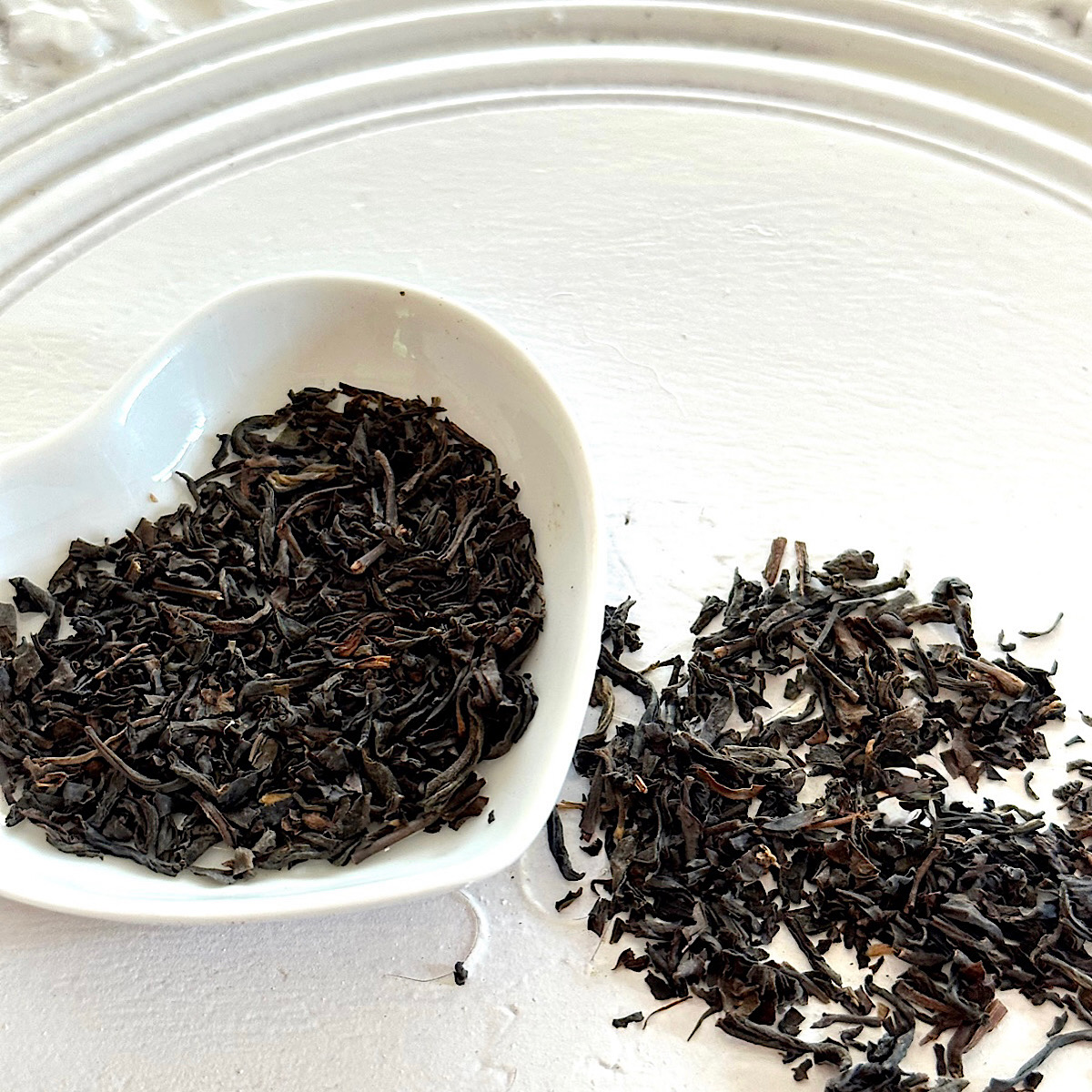
The aroma hits you the moment hot water touches the leaves. Some people describe it as campfire smoke. Others say smoked bacon, pine resin, whiskey, or even a well-worn leather chair. The room fills with the scent.
The flavor follows the aroma: bold, smoky, with undertones of pine and sometimes a faint sweetness. Quality varies significantly between producers. The best Lapsang Souchong has a mellow, almost sweet edge beneath the smoke. Lower-quality versions can taste harsh (they smell like burnt rubber). If your first experience was unpleasant, try a better grade before giving up on it entirely.
This is a tea that inspires strong reactions. People either love it immediately or find it overwhelming. But many who don’t care for it initially come to appreciate it over time. It’s an acquired taste in the best sense, i.e., worth acquiring.
If you’re new to smoky teas and want to ease into them, look for one called Russian Caravan, which blends Lapsang Souchong with other black teas like Assam and Oolong. The smoke is still present but it’s more subdued.
How to Brew Lapsang Souchong
Brewing Lapsang Souchong follows the same basic principles as other black teas, with a few adjustments:
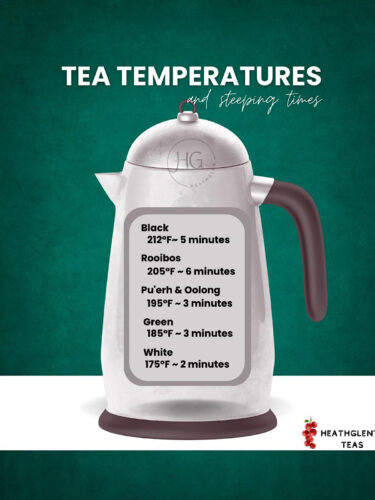
- Water temperature: Use boiling or just under boiling water, around 200-212°F.
- Amount: One teaspoon of loose leaf tea per 6-8 ounces of water.
- Steep time: 3-5 minutes for the first steep. Start with 3 minutes if you’re new to it. The smoke intensifies with longer steeping, but so does potential bitterness.
- Multiple steeps: Good quality Lapsang Souchong can be steeped 2-3 times. Each infusion reveals slightly different flavor notes.
- Drink it plain first. Purists insist on no additions, and I recommend trying it that way at least once to understand the tea’s full character.
If you want to soften the intensity:
- A splash of milk mellows the smoke without masking it too much
- Honey brings out underlying sweetness
- A slice of lemon adds brightness
Iced Lapsang Souchong: This tea makes surprisingly good iced tea. Cold brew it overnight (1 tablespoon per cup of room temperature water, steeped in the refrigerator for 12 hours), then strain. The smoke comes through beautifully cold.
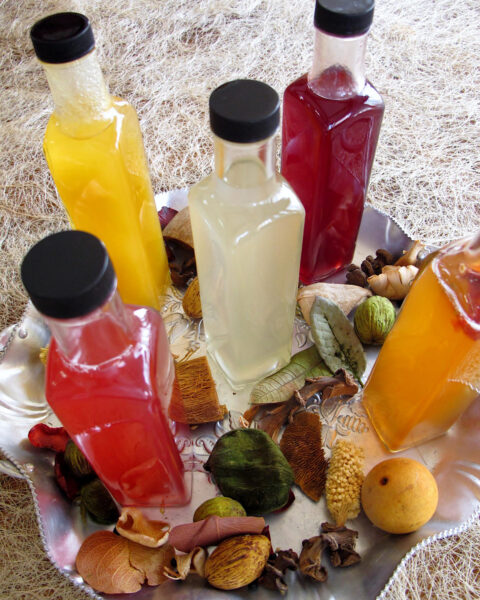
I have many posts that focus on iced tea: how to make big batches, fruit-flavored syrups for iced tea, and Southern Sweet Tea are a few popular ones.
What to Eat with Lapsang Souchong
The smoky intensity of Lapsang Souchong means it pairs best with foods that can stand up to it. Think hearty, savory, rich. Here are a few of my favorite pairings:
- Grilled and smoked meats: This is the natural pairing. Barbecued ribs, smoked brisket, grilled steak, bacon and eggs. The tea’s smoke complements the char and fat of grilled meat perfectly.
- Cheese: Strong, aged cheeses work beautifully. Sharp cheddar, aged Gouda, smoked Gouda, blue cheese. The fat in the cheese mellows the tea’s intensity while the bold flavors match each other.
- A Ploughman’s Lunch: This is my favorite pairing and why I call my Lapsang Souchong blend “Brewer’s Build” at the market. The classic British pub lunch of cheese, crusty bread, pickles, and cold meat was practically designed for this tea. The tangy pickle cuts through the smoke. The cheese provides richness. The bread grounds everything. I’ve written more about this pairing in my post on Ploughman’s Lunch.
- Dark chocolate: The bitterness of high-cocoa chocolate balances the tea’s intensity, creating a smoky-sweet contrast. Try it with raspberry-finished dark chocolate for a nod to Russian tea traditions, where jam was sometimes stirred into smoky tea.
- Mushrooms: Grilled or roasted mushrooms have natural umami that echoes the tea’s savory depth. The pairing is “like with like,” and it works.
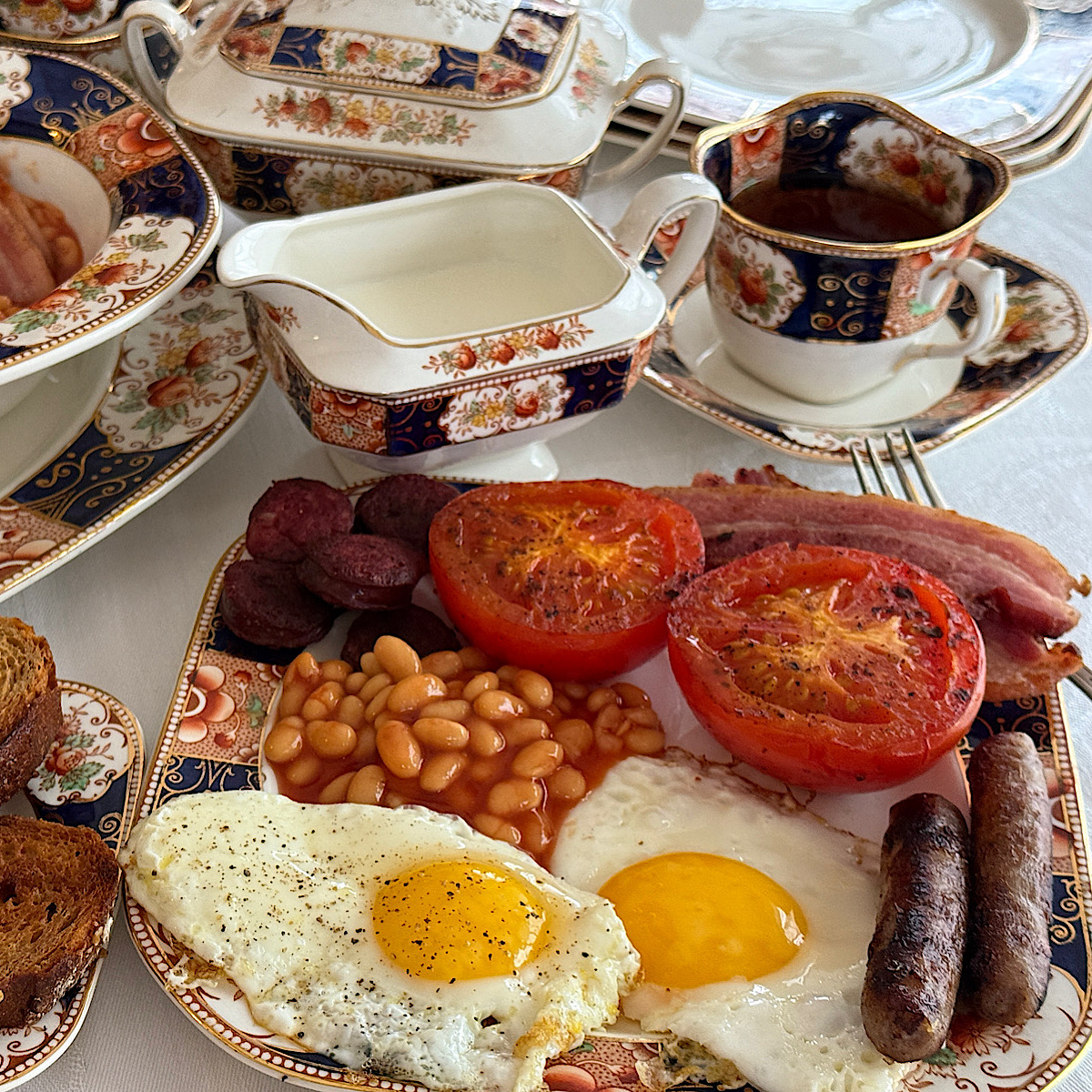
- Eggs: Breakfast with Lapsang Souchong feels right. The tea cuts through the richness of eggs and bacon, and the smoky flavors reinforce each other. A “Full English Breakfast” (see photo below) is a hearty way to start the weekend.
What to avoid: Delicate foods get overwhelmed with strong teas. Light salads, subtle fish, mild cheeses, and anything you’d pair with green tea will disappear next to Lapsang Souchong.

Cooking with Lapsang Souchong
Here’s where this tea can really shine. Even people who don’t enjoy drinking Lapsang Souchong often love cooking with it. The smoke flavor transfers beautifully to food without requiring a grill or smoker.
Two methods:
- As a liquid: Brew the tea strong (2 teaspoons per 6 ounces of water, steeped 3-4 minutes) and use the liquid in marinades, brines, sauces, soups, and stews. It adds smokiness the way liquid smoke does, but with more complexity and depth.
- As a dry ingredient: Grind the leaves to a powder using a spice grinder or mortar and pestle, then use as a rub or add directly to dishes. A little goes a long way.
Recipes to Consider Trying:
- Tea-smoked duck: This is the classic. Sichuan tea-smoked duck uses Lapsang Souchong (along with rice and sometimes camphor) to smoke the duck indoors. The tea creates a mahogany-colored, intensely flavorful skin. Even simpler: use brewed tea as a marinade for duck breast, then pan-sear it.
- Lapsang-brined pork: Brine pork tenderloin or chops in cooled, strong-brewed tea with salt and sugar. The smoke penetrates the meat during brining, and the pork emerges with subtle smoky flavor throughout.
- Salmon with tea rub: Grind the tea leaves with salt, pepper, and paprika. Coat salmon fillets and pan-sear. The crust develops a beautiful smoky char.
- Smoky lentil soup: Add a tablespoon of ground Lapsang Souchong to lentil or split pea soup. It provides the smoky depth that ham hock traditionally adds, making it an excellent option for vegetarian cooking.
- Lapsang-infused oil: Combine loose tea with oil (8 parts oil to 1 part tea by volume), blend, and let steep in the refrigerator for 2 days. Strain through cheesecloth. Use as a finishing oil on roasted vegetables, soups, or pasta.
- Infused jam: Simmer fruit preserves with strong-brewed Lapsang Souchong until reduced and thickened. The smoky jam pairs wonderfully with sharp cheeses.
My Lapsang Souchong (Brewer’s Build)
At my market stand in St. Paul, Minnesota, I sell a Lapsang Souchong looseleaf tea I call “Brewer’s Build.” The name comes from pairing it with my Ploughman’s Lunch post. The Ploughman’s Lunch was traditionally a pub meal for workers, and this seemed like the perfect mid-day tea for a hard worker taking a break with a wedge of cheddar, some pickled onions, crusty bread, and a pot of smoky tea.
The Brewers Build is a high quality Lapsang Souchong with no additions. I source a medium-smoke version that has the campfire character without being too harsh. It’s bold enough to stand up to strong cheese and pickles, smooth enough to drink on a quiet afternoon.
If you’ve tried Lapsang Souchong before and found it too intense, this might change your mind. And if you’ve never tried it, this is a good place to start.
Other Smoky Teas Worth Knowing
Lapsang Souchong isn’t the only smoky tea, though it’s the most famous.
- Russian Caravan: A blend that traditionally includes Lapsang Souchong along with oolong and other black teas. The smoke is present but softened by the other leaves. A good entry point for newcomers.
- Zheng Shan Xiao Zhong: This is the original, traditional name for Lapsang Souchong from its birthplace in the Wuyi Mountains. Zheng Shan Xiao Zhong processed in the traditional way tends to be more refined and less aggressively smoky than mass-market Lapsang Souchong.
- Tarry Lapsang Souchong: A more intensely smoked version, sometimes produced in Taiwan. The smoke level is dialed up. For dedicated fans of bold smoke only.
- Smoked oolongs: Some oolongs are lightly smoked, offering a gentler introduction to smoky tea.
FAQ
The leaves are dried over smoldering pinewood fires instead of being air-dried or machine-dried like most teas. The smoke infuses the leaves during processing, becoming part of the tea’s essential character.
Yes. There have been questions about polycyclic aromatic hydrocarbons (PAHs) from the smoking process, but reputable producers keep levels well within safe limits. Moderate consumption is not a health concern.
About 30-60 mg per cup, roughly half what you’d find in coffee. The smoking process may slightly reduce caffeine compared to other black teas.
Yes. Quality loose leaf can be steeped 2-3 times. Each infusion will be slightly different, often revealing new flavor notes as the smoke mellows.
Try a higher-quality version first, as cheap Lapsang Souchong can taste harsh. If you still don’t enjoy drinking it, consider using it in cooking instead, where the smoke flavor integrates with other ingredients and becomes more approachable.
Like all tea, it’s best used within a year or two. Store in an airtight container away from light, heat, and strong odors. The smoke flavor will mellow slightly over time.
If you want to explore the world of teas and tisanes, check out this Complete Guide to Teas. It includes information on how to grow a tea garden, types of tea, brewing times and temp., recipes for blends, caffeine amounts, and much more.