
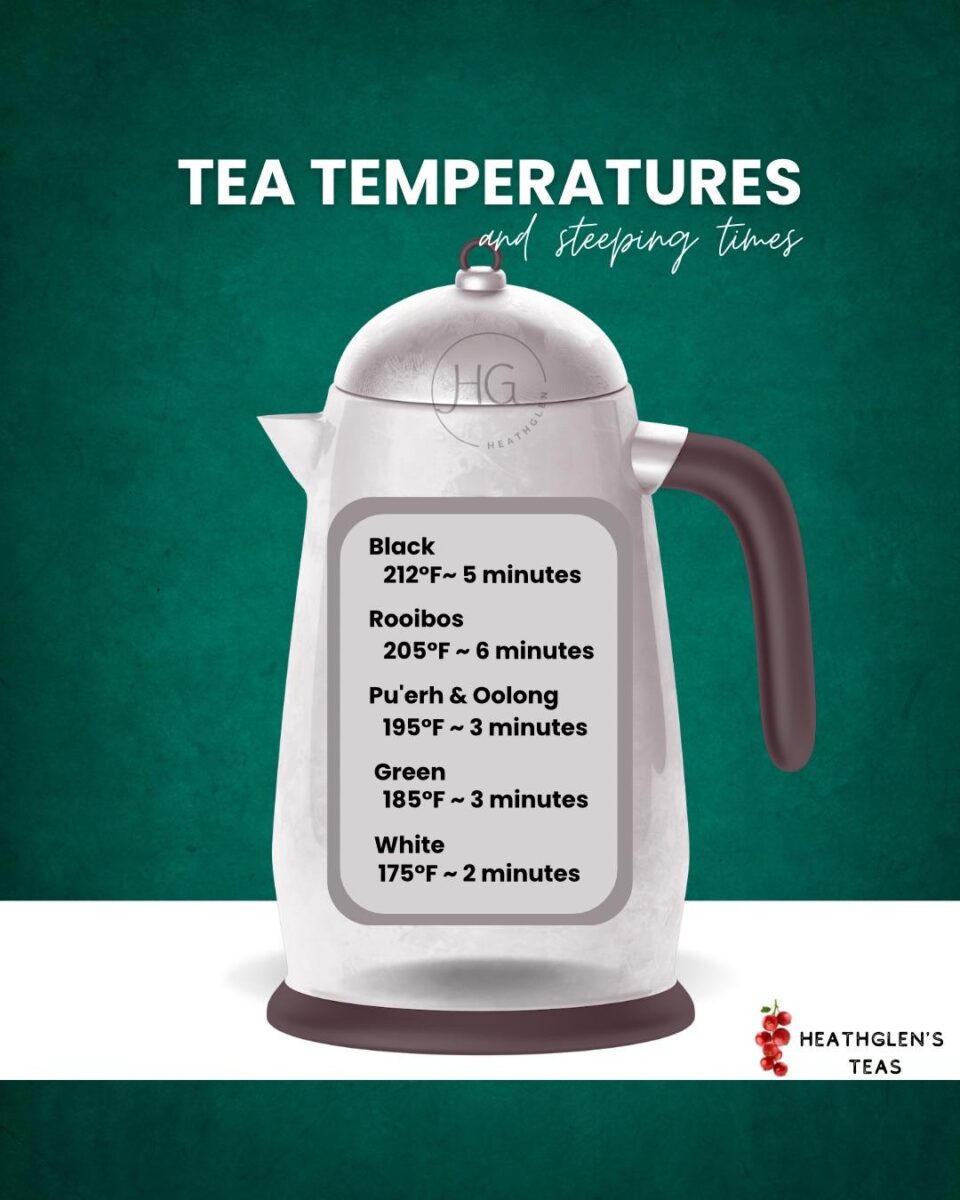
Quick Summary Box: Quick Summary: Black tea steeps at 212°F for 5 minutes, while delicate white tea needs only 175°F for 2 minutes. Using the wrong temperature results in bitter or weak tea. Green and oolong teas fall in between. Read time: 4 minutes | Includes downloadable infographic
Jump to: Temp and Steep Times | Black | Rooibos | Green | White | Oolong & Pu’ehr | FAQ
At HeathGlen Organic Farm, I grow many of the herbs that I use to blend the loose leaf teas I sell at the St. Paul Farmers’ Market. When customers tell me they don’t like green tea because it is bitter, the first thing I ask is what temperature did you steep it at.
Different teas need different temperatures and steeping times to taste their best. Here’s the complete guide I share with my customers.
This post may contain affiliate links. As an Amazon Associate, I also earn from qualifying purchases. You can read our disclosure information here–
Why Does Water Temperature Matter for Tea?
Tea leaves contain tannins, the compounds responsible for that dry, puckering sensation in your mouth and hot water will extract these tannins faster than cooler water. Pouring boiling hot water over the leaves of more delicate teas, like a green or white tea, will cause the tannins to be released too quickly, resulting in a bitter tea.
On the other hand, heartier teas like black tea and rooibos have tougher cell structures and will need high heat to fully release their flavor. If the water poured over a black tea is not hot enough, you will get a weak, flat cup.
The goal is matching your water temperature to the tea’s structure so you extract flavor without extracting bitterness.
This is why tea enthusiasts are so particular about temperature. It’s not pretentiousness, but rather the difference between enjoying the full range of teas versus making a snap judgement on a particular tea.
What Happens If You Use the Wrong Temperature?
Using water that is too hot for the particular type of tea creates bitter, astringent tea. This is especially noticeable with green and white teas, which become almost undrinkable when scalded with boiling water. The delicate grassy and floral notes disappear, replaced by harsh bitterness.
On the other hand, using water that is too cool for more robust black teas will produce a weak, underwhelming tea. Black tea brewed at low temperatures tastes thin and bland because the leaves never fully open and release their depth.
You might be tempted to steep longer to compensate, but extended steeping at any temperature eventually turns bitter.
Steeping too long releases excess tannins regardless of temperature. Even properly heated water creates bitter tea if you leave the leaves in too long. This is why steeping time matters as much as temperature.
Black Tea: Steep at 212°F for 5 Minutes
Black tea is the most forgiving type of tea. It needs boiling water (212°F) and a full 5 minutes to develop its characteristic robust flavor. The leaves of black teas are fully oxidized during processing, which makes them sturdy enough to handle high heat.
If your black tea tastes weak, steep it a little longer rather than adding more leaves. If it tastes bitter, you’ve probably gone past 5-6 minutes.
Black tea is also the most caffeinated of the true teas, so that full steep time gives you the energy boost many people expect from their morning cup.
Common black teas include English Breakfast, Earl Grey, Assam, and Darjeeling. We have quite a range of blends that you can check out on our tea page.
Rooibos Tea: 205°F for 6 Minutes
Rooibos isn’t technically tea, as true teas come from the Camellia sinensis plant. Rooibos, also known as “red bush tea” or “African red tea,” is made from the fermented leaves of the aspalathus linearis shrub, a plant native to South Africa. It is a caffeine-free, naturally sweet herbal alternative to traditional teas.
Like black tea, rooibos is forgiving. It handles near-boiling water (205°F) and benefits from a longer steep of about 6 minutes. Unlike true tea, rooibos doesn’t turn bitter with extended steeping, so if you forget about your cup for a few extra minutes, it’s still good.
Rooibos makes an excellent base for flavored blends because of its mild, adaptable taste.
Pu’erh and Oolong Tea: 195°F for 3 Minutes
Pu’erh and oolong teas fall in the middle of the temperature range. Both are partially oxidized (oolong) or fermented (pu’erh), giving them more complexity than green tea but less sturdiness than black.
Both Pu’erh and Oolong prefer water around 195°F, which is below boiling but still quite hot, and favor steep times for about 3 minutes. Oolong unfurls dramatically in hot water, so use a vessel that gives the leaves room to expand. Pu’erh has an earthy, almost mushroomy depth.
Many people are put off by the taste of Pu’erh until they get used to it. At HeathGlen I blend Pu’erh with cocoa nibs and cinnamon bark to add a slight sweetness to the flavor. It has become my go-to tea that I drink daily, both for the health benefits and the flavor.
Both pu’erh and oolong are excellent candidates for multiple infusions. The second and third steeps often taste different from the first as different flavor compounds release.
Green Tea: 185°F for 3 Minutes
Green tea is where temperature mistakes show up most dramatically. Boiling hot water scorches the leaves and destroys the delicate, grassy, vegetal flavors that make green tea appealing. The result is a bitter, harsh tea that puts a lot of people off of green tea forever.
Drop your water temperature to 185°F and keep steeping time to about 3 minutes. The tea should taste fresh and slightly sweet, with none of that puckering bitterness.
If you’ve always thought you didn’t like green tea, try it at the correct temperature before giving up on it entirely.
Japanese green teas like sencha and gyokuro are especially sensitive to temperature. Chinese green teas like dragonwell are slightly more forgiving but still benefit from cooler water.
White Tea: 175°F for 2 Minutes
White tea is the most delicate of all tea types. The leaves are minimally processed. They are only withered and dried, which preserves their subtle, almost honeyed sweetness. That delicacy means they can’t handle much heat.
Use water around 175°F, well below boiling, and steep for only 2 minutes. White tea should taste soft and slightly floral. If it tastes bitter or flat, your water was too hot or you steeped too long.
White tea has the lowest caffeine content of the true teas, making it a good choice for afternoon or evening drinking.
How to Check Water Temperature Without a Thermometer
I use a temperature-controlled kettle which has the preferred temperatures for each type of tea noted on the handle. Even though I blend teas for market sales and am a tea enthusiast, I find it a lot easier to push the correct button on the kettle rather than remember which temperature I want for each type of tea. And I certainly don’t have the discipline to use a thermometer in a pot of water.
The most popular type of electric kettle is a gooseneck version. While these gooseneck types are popular, I prefer this type of kettle that pours the water out faster (I’m an impatient sort). You can certainly get less expensive ones at Walmart also, and they work perfectly fine.
Not everyone has a temperature-controlled kettle however, and if you don’t want to go the thermometer route, here’s how to estimate water temperature using visual cues:
Around 160-170°F: Tiny bubbles form on the bottom of the pot but don’t rise. The water is steaming but quiet. This is approaching white tea territory.
Around 175-185°F: Small bubbles begin rising in streams from the bottom. The water is steaming steadily. Good for white and green teas.
Around 195-205°F: Larger bubbles rise rapidly and the surface is agitated. This is the range for oolong, pu’erh, and rooibos.
212°F (boiling): Rolling boil with large bubbles breaking the surface continuously. Use this for black tea.
The simpler method: Boil your water and let it sit. After 30 seconds off the boil, you’re around 200°F. After 2-3 minutes, you’re in green tea range. After 5 minutes, you’ve hit white tea temperature. This isn’t precise, but it works.
Frequently Asked Questions
Green tea steeps best at 185°F for about 3 minutes. Boiling water makes green tea bitter and astringent. If you don’t have a thermometer, let boiling water cool for 2-3 minutes before pouring over green tea leaves.
Yes. Over-steeping releases excess tannins, making tea bitter regardless of the type. Black tea becomes astringent after 5-6 minutes, while delicate white tea turns bitter after just 3-4 minutes.
Most herbal teas (including rooibos) can handle boiling water because they don’t contain the same tannins as true tea leaves. Boiling water helps extract the full flavor from dried herbs, roots, and flowers.
Yes. Heavily chlorinated or mineral-heavy water changes how tea tastes. Filtered water produces cleaner, more accurate tea flavor. If your tap water tastes off on its own, it will affect your tea.
If you want to explore the world of teas and tisanes, check out this Complete Guide to Teas. It includes information on how to grow a tea garden, types of tea, brewing times and temp., recipes for blends, caffeine amounts, and much more.
Hi Dorothy! This is Angie K….am I able to order your amazing tea online? I had a sample and LOVE it! Thank you!
Hi Angie. I used to sell it online but the shipping and packaging got too expensive for me. Here is a page showing the various kinds that I have and then you can email me with your preference and I’ll bring it to class. Here’s the page: https://farmtojar.com/shop-teas/ and my email is dsheathglen@gmail.com