
Quick Summary: Smoky, spicy, and deeply savory, ajvar is a roasted red pepper and eggplant spread from the Balkans. This Kosovo-inspired version gets extra heat from a Peruvian hot spice blend. Roast, peel, blend, and serve with fish, eggs, sandwiches, or a cheese board. Prep: 10 min | Cook: 30 min | Makes: 40 tablespoons
Jump to: | RECIPE | What is Ajvar | How to Roast and Seed Peppers | What to Serve with Ajvar | Video
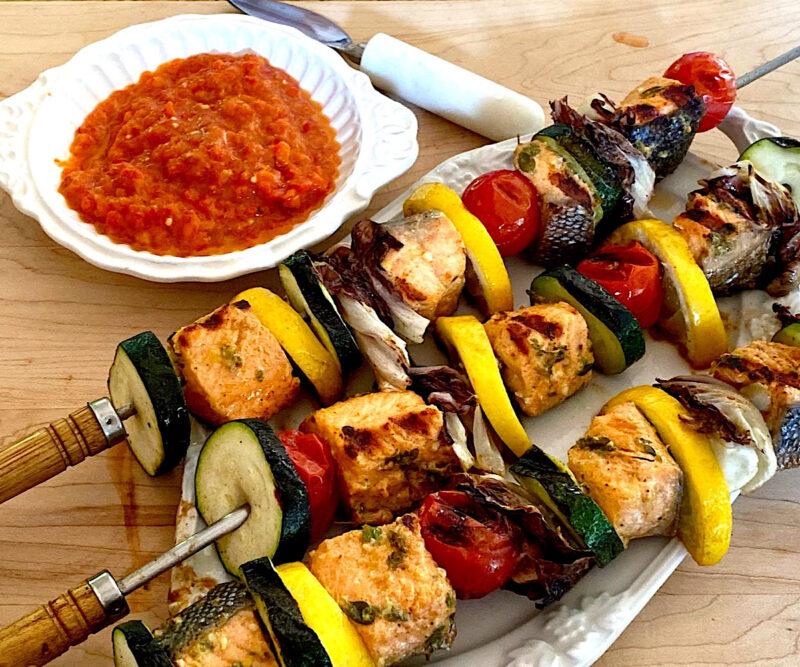
What is Ajvar?
Ajvar is a condiment made from red sweet peppers and eggplant. It is traditionally served in the Balkan region (including Serbia, Macedonia, Albania, Kosovo) Each particular region has a slight variation on the recipe. My version is inspired by a classic recipe from Kosovo that my daughter learned from her college room-mate.
Traditional Kosovo recipes use a pepper known as Red Bull’s Horn Pepper. Red Bull’s Horn is a sweet pepper that got its name from its shape. This particular pepper is not readily available in many US grocery stores however, so I opted for sweet red “bell” peppers.
Red Bull’s Horn peppers are a bit sweeter than red bell peppers. They are also a deeper red color, which offsets the pale flesh from the eggplant and gives the ajvar it’s traditional deep red color.
Ingredients
The following photo shows you all the ingredients you will need for this recipe. For details on measurements, see the recipe below.
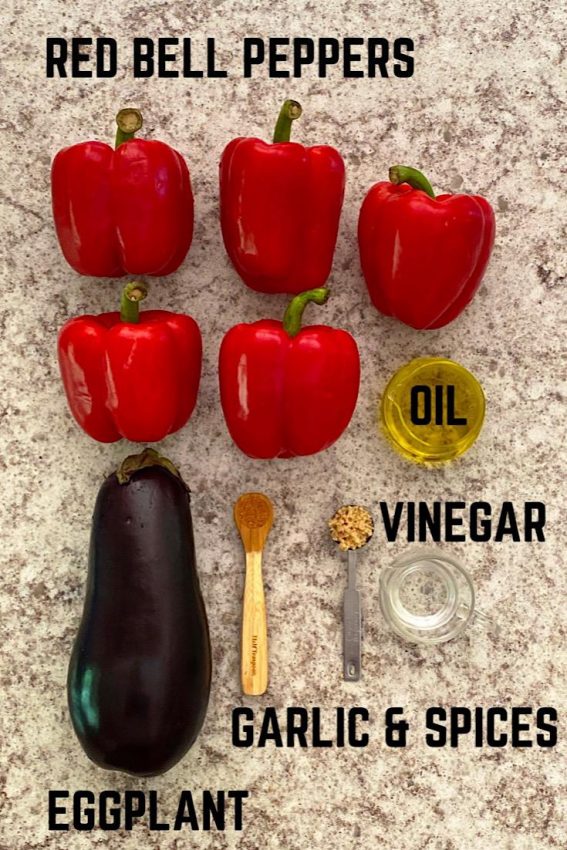
For a smokier version, char the peppers on a grill. For the heat component, I love spicy foods so I made the Ajvar with a Peruvian hot spice blend, which is extremely spicy! You can tone it down with a milder pepper or a sweet pepper blend if you want a sweeter ajvar.
How to Roast and Seed the Peppers
Whether you use red bell peppers or Red Bull’s Horn, the key is to roast the peppers and eggplant. Typically, I like to roast peppers over our gas stove, holding and turning them with metal tongs.
However, because there are a lot of peppers and because roasting a large eggplant with this method would be awkward, I used the oven to roast the vegetables.
The oven is actually a much quicker way to roast vegetables. Traditional Kosovo ajvar is made on an outdoor open fire pit.
In the step by step video (within the recipe card), I baked the peppers on a lined baking sheet at 475 F degrees for 15 minutes and then broiled them on the high broil setting for the remaining 15 minutes.
Although I think they would have turned out fine if they were just left to bake, I wanted to get a more charred effect that you would get with the broil. The peppers turned out pretty black, so I think I managed to get the charred effect!
The other part of the recipe that can take more time is seeding the peppers and eggplant, but the effort is worth it for ajvar aficionados. Our family isn’t too particular about seeds, so I didn’t seed the eggplant as much as I probably could have.
Roasted red bell peppers can take forever to seed thoroughly. However, I recently saw a trick online about running the peppers through cold water and washing the seeds off. That worked like a charm!
How to Save Time on the Sauce
Many people comment that the most daunting part of making ajvar is the amount of time it takes to make the sauce. I definitely wanted to keep all the flavor but also wanted to save time.
Traditional Kosovo ajvar is made by using a hand grinder (like a meat grinder), but I don’t know that I have the strength or time for that, so I used the food processor, which worked just fine.
How to Store Ajvar
Ajvar keeps in the refrigerator for 2-3 weeks in an airtight jar. For longer storage, you can water bath the jars for 10 minutes, which extends the shelf life to several months.
Freezing works well too, just pour the ajvar into small containers or ice cube trays and freeze for up to 6 months. Thaw overnight in the refrigerator before serving.
What to Serve with Ajvar
Ajvar, though it has a very distinct flavor, goes well on almost anything. When my daughter visited her college friend in Kosovo, she had ajvar on a tuna fish sandwich, which was the inspiration for asking me to recreate it at home.
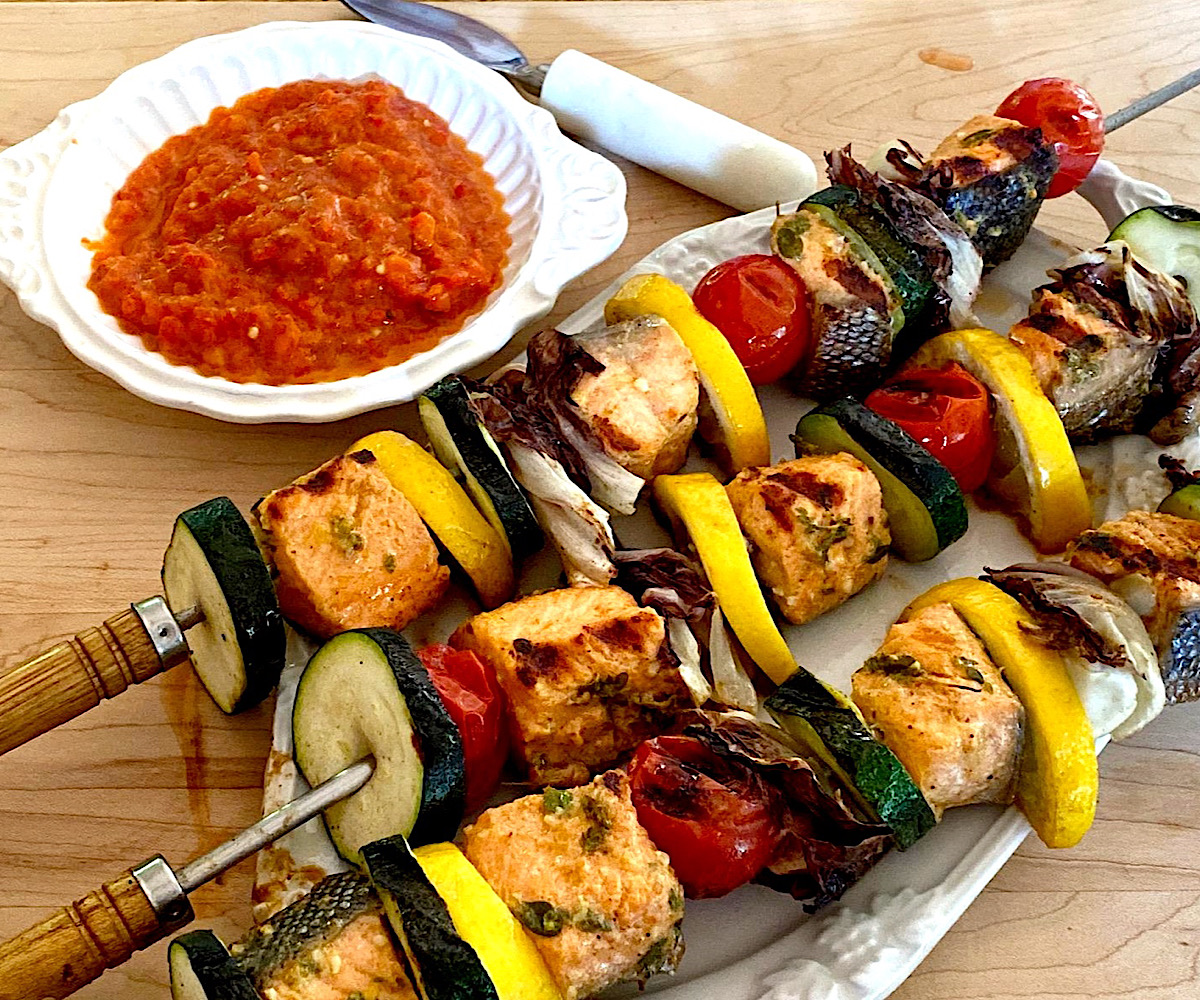
Instead of tuna, I made these salmon kebabs and used the ajvar as a dipping sauce. This spread pairs beautifully with fish or seafood if you are following the Pesco Mediterranean diet.
We’ve also been eating it on sandwiches with Cotto salami, and for breakfast on fried and scrambled eggs.
I also made ajvar as an addition to our Chicago dog bar for Father’s Day, which was delicious as well. The cold and zingy ajvar pairs well with the warm hot dogs.
Ajvar keeps well refrigerated and is a great way to preserve a surplus of red peppers from your garden or the farmers market. For more ways to preserve your summer harvest, check out these 10 ways to preserve fresh fruits, vegetables and herbs.
FAQ
Ajvar is a roasted red pepper and eggplant spread from the Balkan region, popular in Serbia, Kosovo, Macedonia, and Albania. It ranges from mild and sweet to quite spicy depending on the recipe. It’s typically served as a condiment, dip, or sandwich spread.
It depends on the recipe. Traditional ajvar can range from sweet to very hot. This version uses a Peruvian hot spice blend and is medium-hot. For a milder version, substitute sweet paprika or use only sweet peppers.
Almost anything. It’s excellent on sandwiches, with grilled fish or salmon, on eggs (scrambled or fried), as a dip with crackers or pita bread, on cheese boards, with hot dogs, or stirred into pasta. It pairs especially well with rich or smoky proteins.
Refrigerated in an airtight jar, 2-3 weeks. Water-bathed, several months. Frozen, up to 6 months.
Yes. It’s made from roasted peppers, eggplant, olive oil, and spices with no added sugar. It’s fully compliant with the Slow Carb Diet and any low carb plan. A great condiment for adding flavor to simple proteins.
No, though they share some similarities. Ajvar is a Balkan spread made with roasted red peppers and eggplant. Romesco is a Spanish sauce made with roasted red peppers and almonds. Both are delicious on grilled proteins, but they have distinct flavor profiles.
Kosovo Style Ajvar
Equipment
- large bowl
Ingredients
- 5 red bell peppers
- 1 eggplant
- ¼ cup olive oil
- 1 tablespoon white vinegar
- ½ teaspoon Peruvian Hot Pepper Spice or spice of your preference
- 2 cloves garlic minced
- salt & pepper to taste
Instructions
- Preheat the oven to 475°F. Prepare a baking sheet with tin foil and place the eggplant and peppers on the baking sheet.5 red bell peppers, 1 eggplant
- Bake the peppers and eggplant for 30 minutes, turning once at the 15 minute mark. Alternatively, roast the peppers and eggplant on the grill or broil them for about 10 minutes in the oven.
- Place peppers and eggplant in a large bowl or large plastic bag. Cover or seal the bowl. Allow to rest for 20-30 minutes.
- Peel and seed the peppers and eggplant. See recipe note and video for a tip to speed up the seeding process.
- Place peppers and eggplant in a food processor, and add salt and pepper. Pulse a couple of times to mix and then puree almost to the desired smoothness.salt & pepper
- Add oil, vinegar, garlic and spices. Pulse a few times and then puree.1/4 cup olive oil, 1 tablespoon white vinegar, 1/2 teaspoon Peruvian Hot Pepper Spice, 2 cloves garlic
- Pour into jars, a large bowl or a serving dish
I used a combination of green/red bells. A wonderful earthy taste 👍🏼
Thanks for letting me know how it turned out. I think the combination of peppers adds layers and complexity which is always nice. For some reason a lot of people don’t like green bell peppers though.
Made a half batch – wonderful taste! Will go well with my Kosovo Global Table Adventure meal!! Thank you!
Thank you so much for letting me know it worked out for you! The Kosovo Global Table Adventure meal sounds fun (and tasty)!