
Quick Summary: Thin slices of beef rolled around prosciutto, pine nuts, garlic, and sharp Pecorino, then simmered for hours until the meat is tender and the tomato sauce tastes like Sunday dinner. A Sicilian-style celebration dish developed with my Italian friend Gloria Baldino. Prep: 30 min | Cook: 2 hr 30 min | Serves: 6
Jump to: RECIPE | What is Braciole? | The Beef | The Filling | The Sauce | Step-by-Step Directions | What to Serve with Braciole | FAQ

Braciole is the kind of dish that Italian cooks adore. Thin beef rolled around a filling of prosciutto, pine nuts, garlic, parsley, and sharp Italian cheese, tied with twine, seared, and then simmered for hours in a robust tomato sauce.

The meat flavors the sauce. The sauce tenderizes the meat. It’s a marriage made in heaven, as my Italian friend Gloria says.
This Sicilian-style version became famous after appearing in the the FX series “The Bear.” Gloria and I tested it twice to get it right.
She’s from a Southern Italian family (grandparents from Triggiano, near Bari), and she agreed to let me try the Sicilian version with pine nuts and prosciutto. She loved it so much it’s now her go-to recipe for braciole.
This post may contain affiliate links. As an Amazon Associate, I also earn from qualifying purchases. You can read our disclosure information here–
What Is Braciole (Beef Involtini)?
Braciole (brah-ZHOH-leh), the Italian American pronunciation, refers to the construction: rolled, stuffed meat that’s seared and then simmered in tomato sauce for 2-3 hours. The name comes from brace, the Italian word for hot coals, because the first braciole were slices of meat grilled over embers.
Standard Italian pronunciation is brah-CHOH-lehis. Braciole is also called involtini in some regions.
Over the years, braciole has been made with various cuts of beef and pork, but thin-sliced top round or pounded flank steak are most common today.
The Best Cut of Beef for Braciole
Thinly sliced top round is the best cut of beef for braciole. It rolls easily, needs no pounding, and turns tender in the long simmer.
- Our first try: Flank steak. We made one large roll without pounding it. The result looked beautiful when sliced into rounds, but the meat was tougher than we wanted.
- Our second try: Thinly sliced top round. Cut Milanese-style (very thin), each slice became its own individual braciola. No pounding needed. The result was tender, flaky, and delicious.
- Our recommendation: Use top round sliced extra thin. If you use flank steak, pound it thoroughly with a meat mallet first. Either way, the long simmer in tomato sauce does most of the tenderizing work.
Gloria’s shortcut: Costco sells very thinly sliced beef meant for shabu shabu. She layers two slices for each braciola and gets small, tender rolls with no pounding at all. She also makes triple batches and freezes them.
The photo below shows the large flank steak we used the first time. If you use flank steak please do pound it out with a meat mallet!

Whether you use flank steak or smaller slices of top round, the key is slow cooking for 2 – 3 hours in the robust tomato sauce.
Also, whether you use a large flank braciole or several small top round little bracioles, make sure and sear them on all sides first before adding the ingredients for this most delicious tomato sauce.
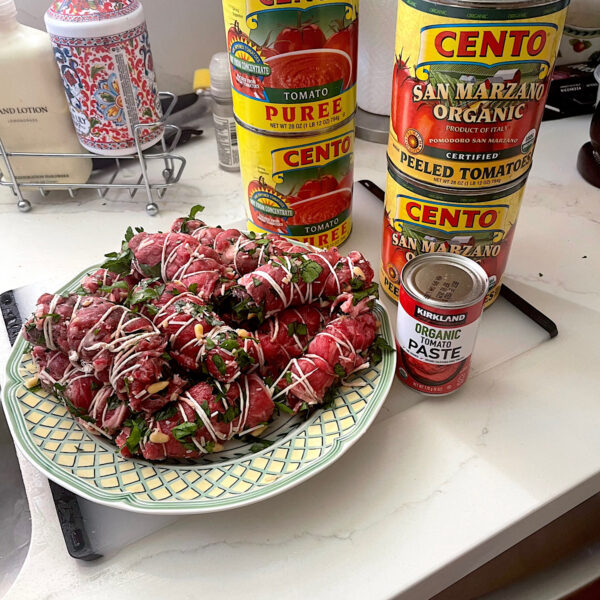
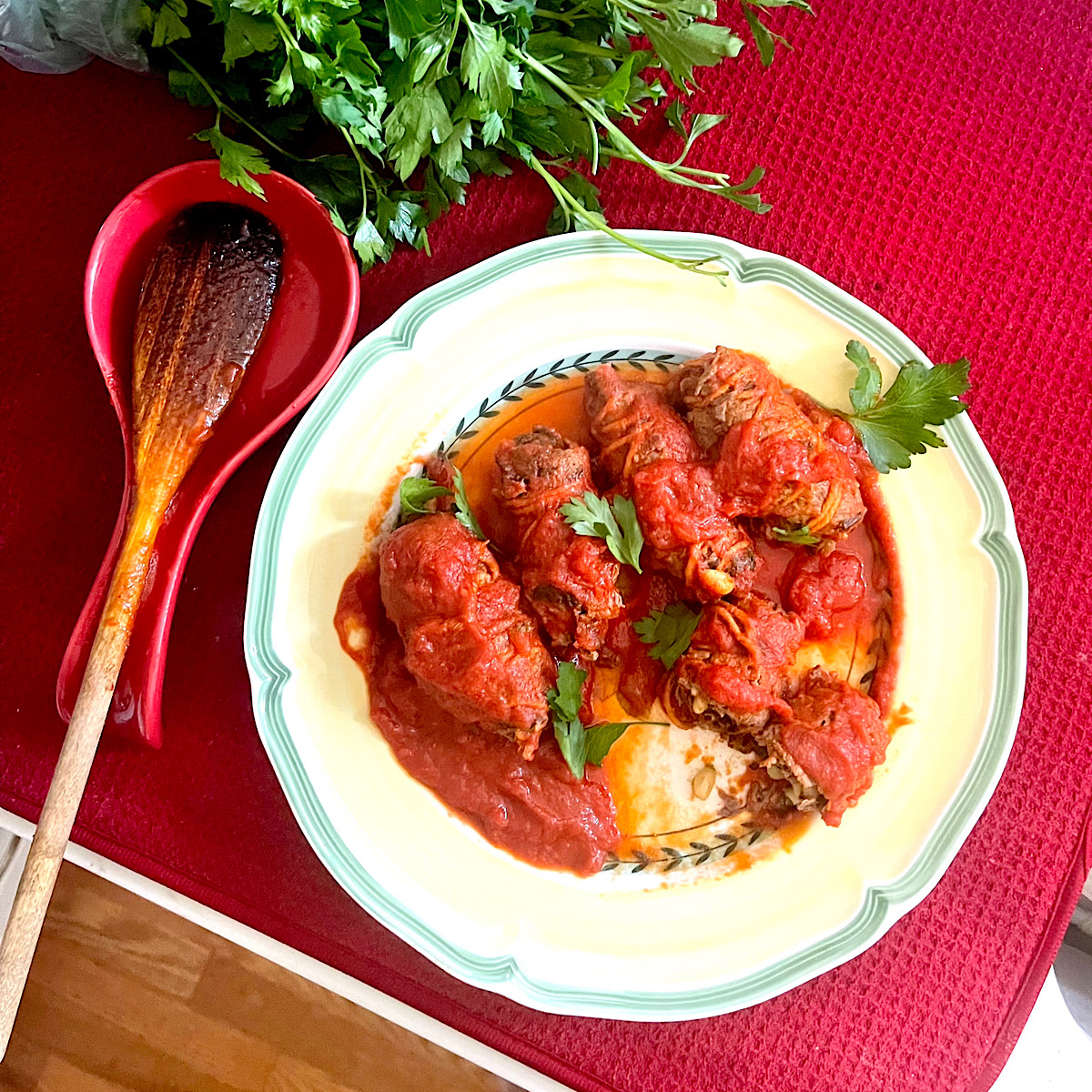
The photo below shows our second batch of the little top round bracioles, stuffed, rolled, tied and just waiting to be seared and then slow cooked in my favorite robust Italian tomato sauce.
The Right Cheese: Parmigiano Reggiano
My Italian BFF feels very strongly about the cheese! She insists that only Parmigiano Reggiano (properly aged) and Pecorino Romano are worthy of this dish.
These cheeses can be pricey, but if you are willing to get a large block (2 pounds each), Costco often carries these – great quality and price! You can grate them by hand with a large grater or a microblade kitchen grater.
Braciole Filling: Prosciutto, Pine Nuts and Cheese (Raisins Optional)
The filling for authentic Italian braciole is often very simple and straight-forward, using breadcrumbs, cheese, garlic, and Italian parsley.
Different regions of Italy, of course, have developed their own versions of braciole, incorporating in different combinations of cheeses (i.e., provolone, Parmesan Reggiano and/or Pecorino Romano).
In Sicily, pine nuts, raisins and sometimes hard boiled eggs are added along with the breadcrumbs. Some Italian cooks will swear by also adding caramelized onions, and specific herbs such as basil or oregano.
The bottom line is the filling can easily be customized to your family’s preferences.
Substitutions for the Filling:
- Raisins with the pine nuts
- Hard-boiled egg
- Red peppers
- Mozzarella cheese
- Parmesan cheese with Romano cheese
- Fontina or provolone cheese
- Spinach
Tomato Sauce for Braciole
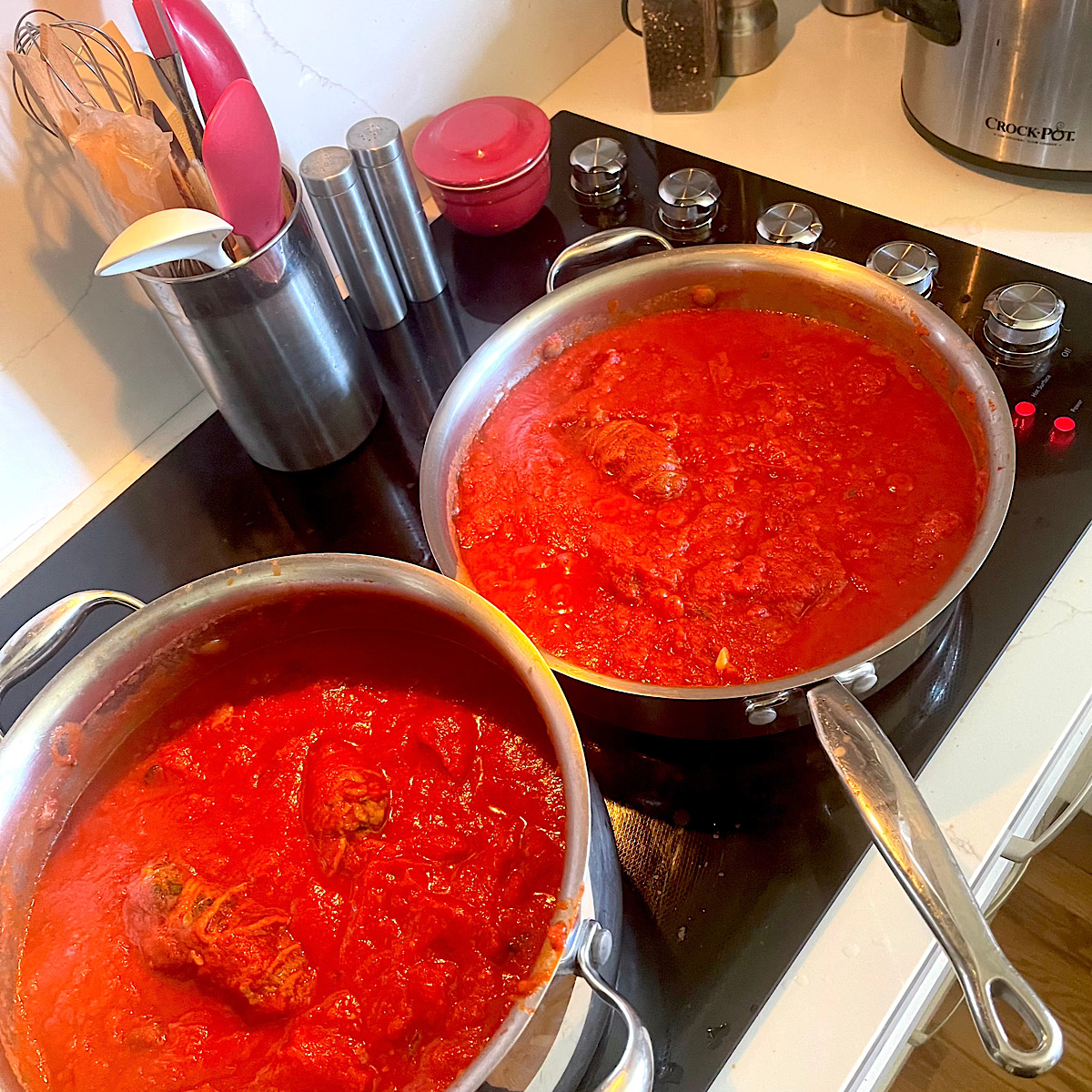
The magic happens during the 2-3 hour simmer. The braciole releases its flavors into the sauce while the sauce permeates the meat. Use this sauce for the rigatoni on the side. Some cooks add a parmesan rind to the simmering sauce for extra richness.
Most Italian tomato sauces seem to be very simple, but because they are so simple you need to use high quality ingredients.
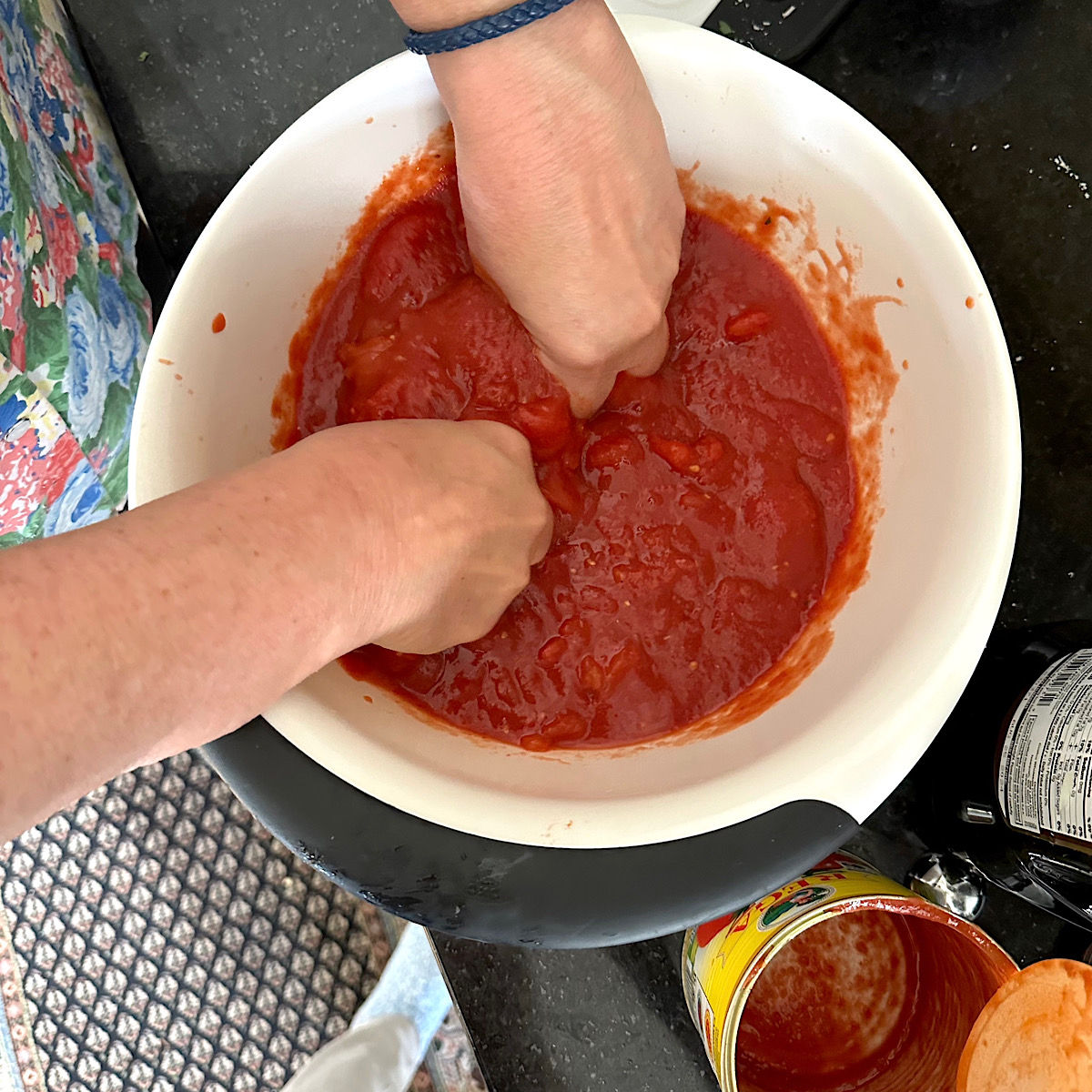
We used canned Italian whole San Marzano tomatoes and crushed them with our hands instead of buying canned crushed tomatoes (which are often processed).
The passata is the Italian form of tomato puree and it is important that the ingredients are simple without herbs and flavorings added.
After those two ingredients are taken care of, a little tomato paste brings the texture together. Many cooks will add red wine to glaze the bracioles before adding the tomato sauces (we did!).
The tomato sauce is further flavored by the onions, garlic and meat that it simmers with for hours, bringing everything together in beautiful Italian harmony.
**Note: It is also important to get quality rigatoni if you are serving this with your braciole!
Ingredients for Sicilian Braciole
Here is a photo of the specific ingredients we used in the recipe below, with the flank steak. Same ingredients as when we made the braciole a second time but with small thinly sliced round steak.

Interested in growing a complete Italian kitchen garden? Check out this detailed guide to designing and growing an Italian Kitchen Garden.
How to Make Braciole (Step by Step)


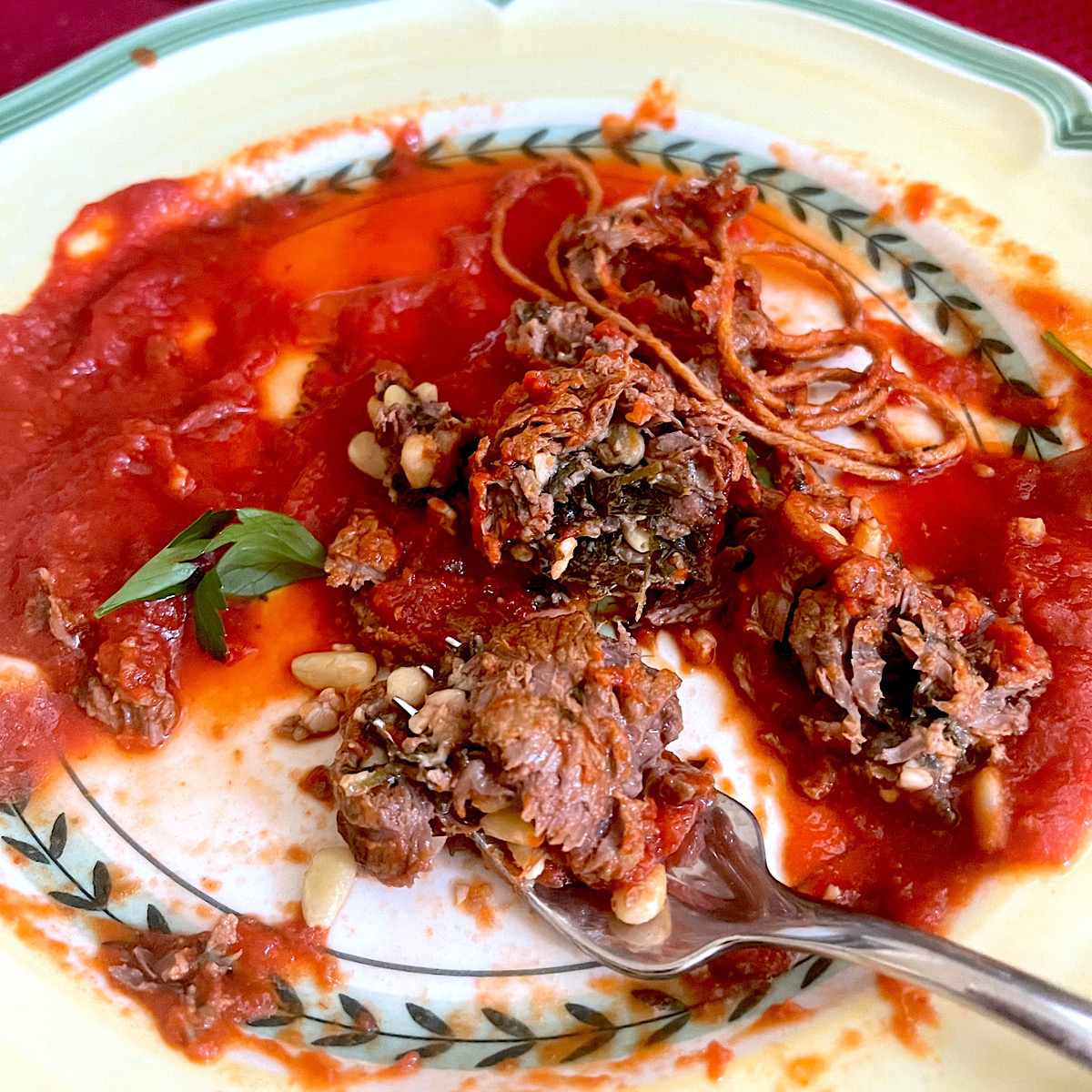
Tip: You can refrigerate the sauce and braciole overnight to serve the following day, serve it the same day and also freeze it for later.
If slow-braised dishes like this one are your style, you’ll find more in my soups and stews collection, from gumbo to pozole to cioppino.
What to Serve with Braciole
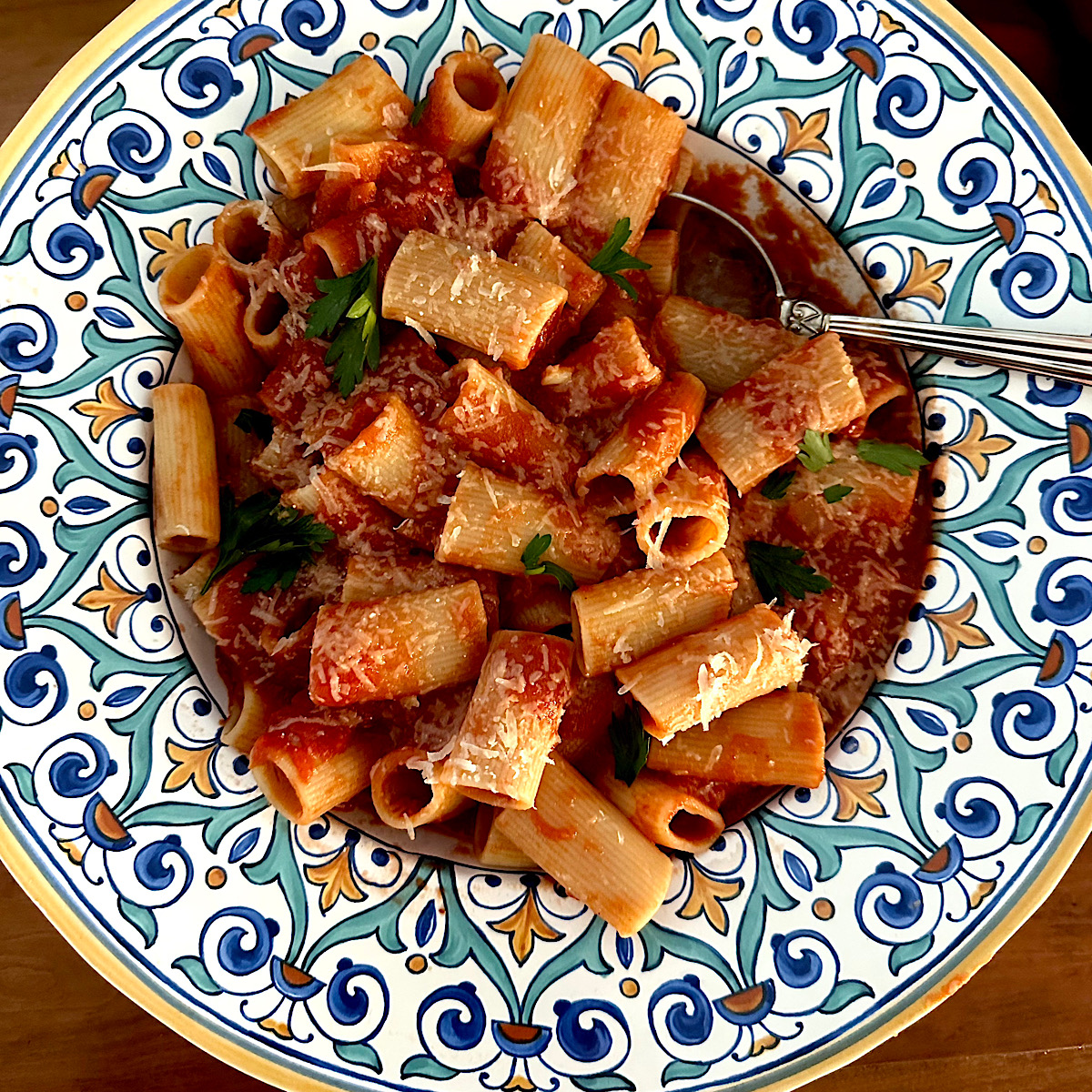
Rigatoni dressed with the braising sauce is the classic side, along with crusty bread and a simple green salad.
For a vegetable, I like Romano beans with smashed cherry tomatoes, which you can make while the braciole simmers.
FAQ
They’re essentially the same dish. “Braciole” is more common in Southern Italian and Italian-American cooking. “Involtini” is used more broadly in Italy. Both mean rolled, stuffed meat.
Yes. The dish actually improves overnight. Refrigerate the braciole in the sauce and reheat gently the next day. The flavors continue to meld.
Yes. Freeze the braciole in the sauce for up to 3 months. Thaw overnight in the refrigerator and reheat gently.
Mostly. Skip the rigatoni and serve it with a green salad or white beans. The filling has a small amount of hard cheese, which strict slow carb leaves out. Here is my slow carb food list.
The twine holds the filling inside while the meat cooks. Without it, the rolls would unravel during the long simmer. Remove the twine before serving (or before slicing, if using a large flank steak roll).
Gloria insists on properly aged Parmigiano Reggiano and Pecorino Romano. No substitutes. Costco carries both in large blocks at good prices.
Braciole is a traditional Italian celebration dish, often served for Christmas Eve, Christmas Day, or Sunday family dinners. It can be made entirely ahead and reheated the next day (the flavors improve overnight), making it ideal for holidays when you want something impressive without last-minute stress.
Yes. Raisins with pine nuts is traditional Sicilian. We left them out to keep the dish lower carb, but adding a small handful of golden raisins to the filling brings sweetness that balances the tomato sauce beautifully.
I haven’t cooked Marcella Hazan’s version side by side, so I can’t compare them fairly. Her books are Gloria’s favorite Italian cookbooks, and this recipe is Gloria’s family method with the Sicilian additions of pine nuts and prosciutto.
Braciole. In the episode “Debra Makes Something Good,” her braciole is so good that Marie gets jealous. It is also the dish at the center of the first season finale of The Bear.
My Italian friend says “Mangia Mangia!!”

Gloria says: “My nonna Caterina Maino Baldino, her daughter, my aunt Rose, and Sicilian daughter-in-law, my aunt Phyllis, and now my cousins and I and their daughters all wear this front snap button apron! Feels like it’s straight from “the old country” as the older generation used to say!
And although we love to cook our grandma’s recipes from Triggiano, my personal favorite Italian cookbook is any by Marcella Hazan. “
Sicilian Braciole with Pine Nuts and Tomato Sauce
Equipment
- Dutch oven or large sturdy pot
- kitchen twine
- another large pot
- bowls
Ingredients
- 3 pounds top round or flank
- 1 teaspoon salt and pepper
- 10-15 cloves garlic minced
- 3 bunches Italian parsley chopped
- ¼ cup grated Pecorino Romano cheese about 2 1/4 ounces – can use more
- ¼ cup grated Parmesan Reggiano cheese
- ½ cup pine nuts can use more if desired
- 4 ounces prosciutto (8 thin slices) for one large flank steak or 8 small top round steak slices
- 3 tablespoons olive oil
- 1 medium onion chopped
- ½ cup red wine
- 56 ounces canned San Marzano tomatoes whole, crushed by hand
- 48 ounces Italian passata (tomato puree) 2 bottles
- 12 ounces tomato paste (2 small 6 ounce cans)
- 3 inches Parmesan Reggiano cheese rind optional
- 16 ounces rigatoni good quality
Instructions
- FOR THE FILLED BRACIOLE:
- Lay the thin slices of steak on the counter. Very thin top round probably won't need to be pounded, but if you are using a larger flank steak, pound away to tenderize! Season the meat with a little salt and pepper to encourage the juices to come to the surface.3 pounds top round or flank
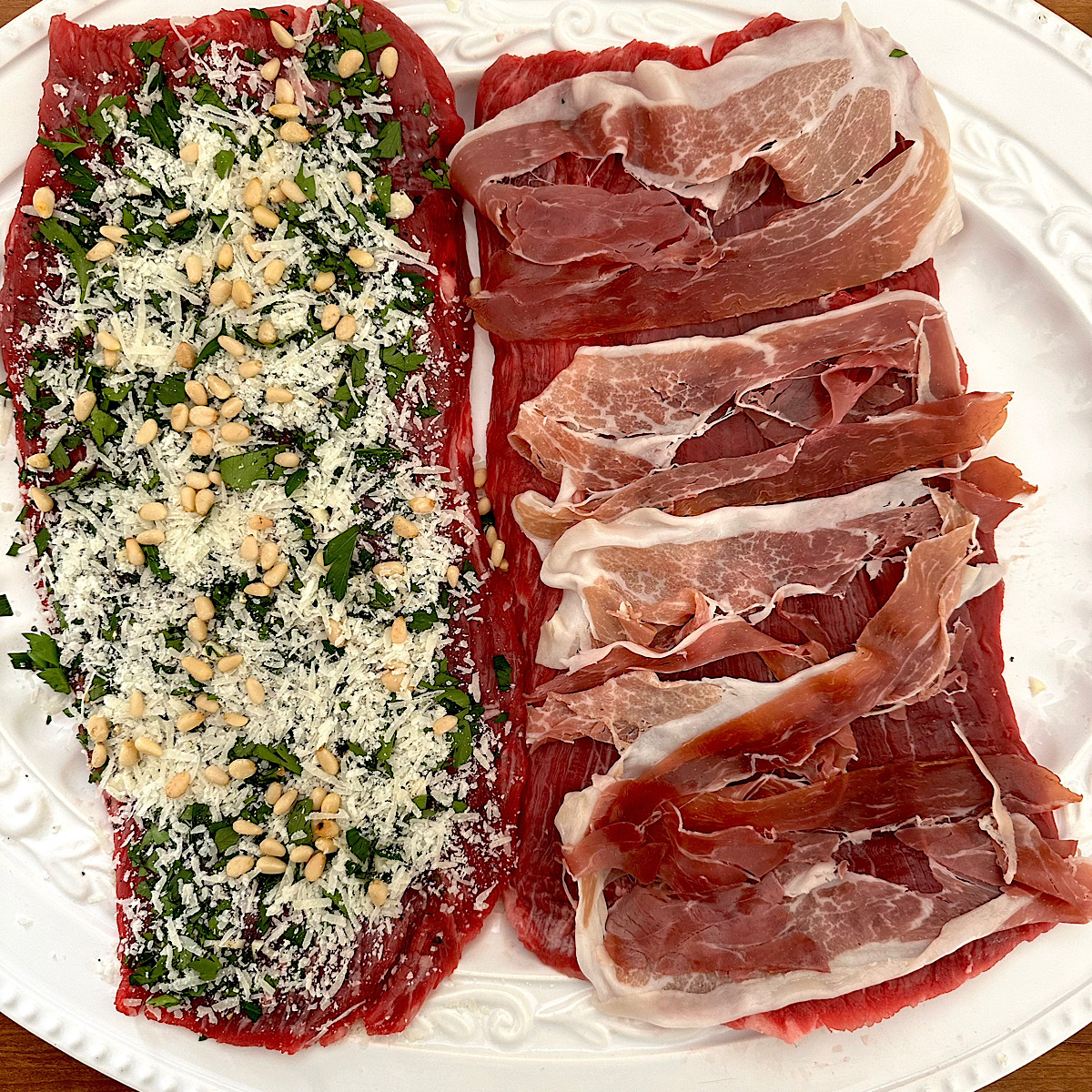
- Prepare the filling by chopping/mincing the garlic, chopping the parsley, and grating the cheese.Lay the steaks out flat and sprinkle the filling evenly over the steaks. Start with the prosciutto. Then add garlic, pine nuts, grated cheeses and finally the parsley. One slice of prosciutto for small thin top round slices, and several slices of prosciutto for a large flank steak log.10-15 cloves garlic, 3 bunches Italian parsley, 1/4 cup grated Pecorino Romano cheese, 1/4 cup grated Parmesan Reggiano cheese, 1/2 cup pine nuts, 4 ounces prosciutto
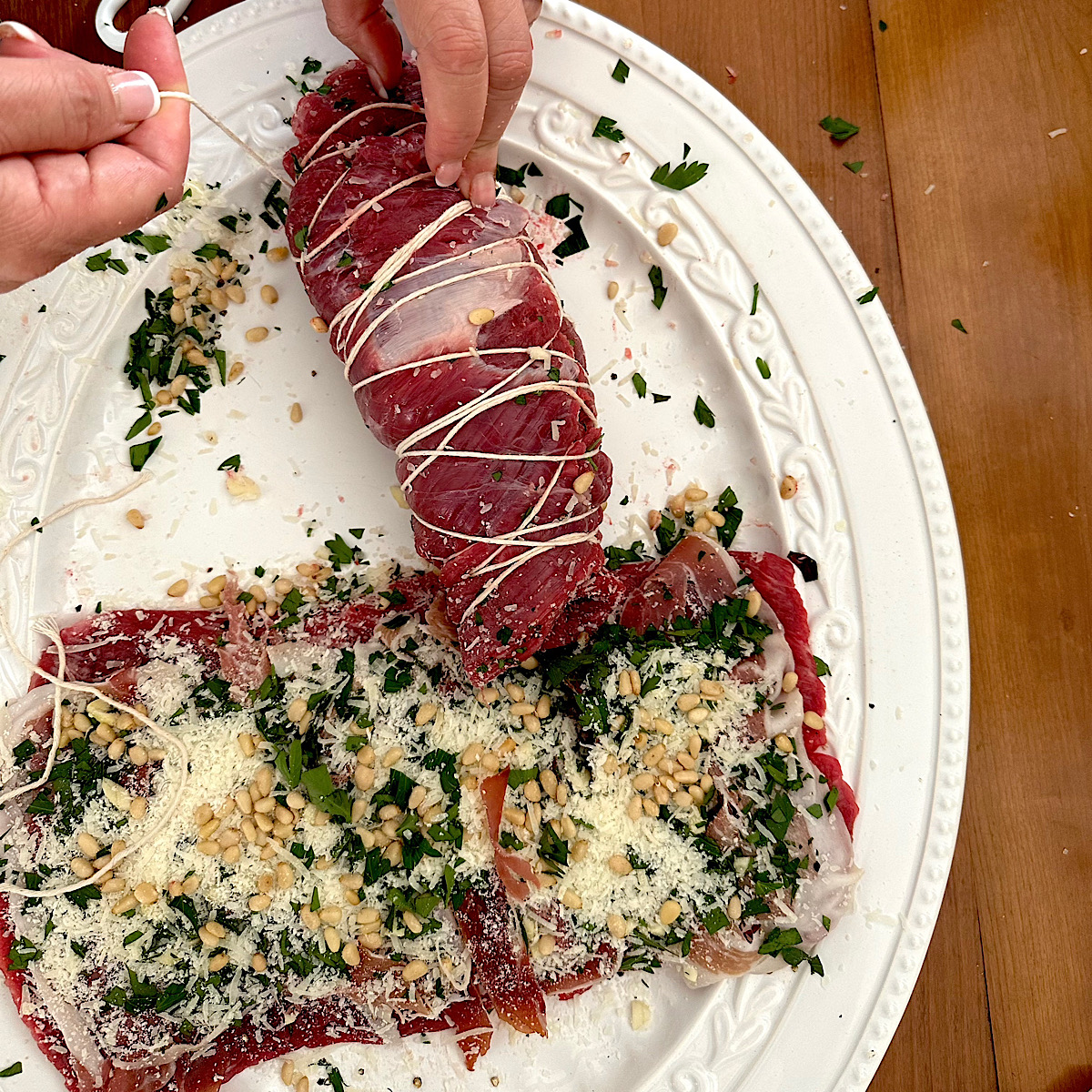
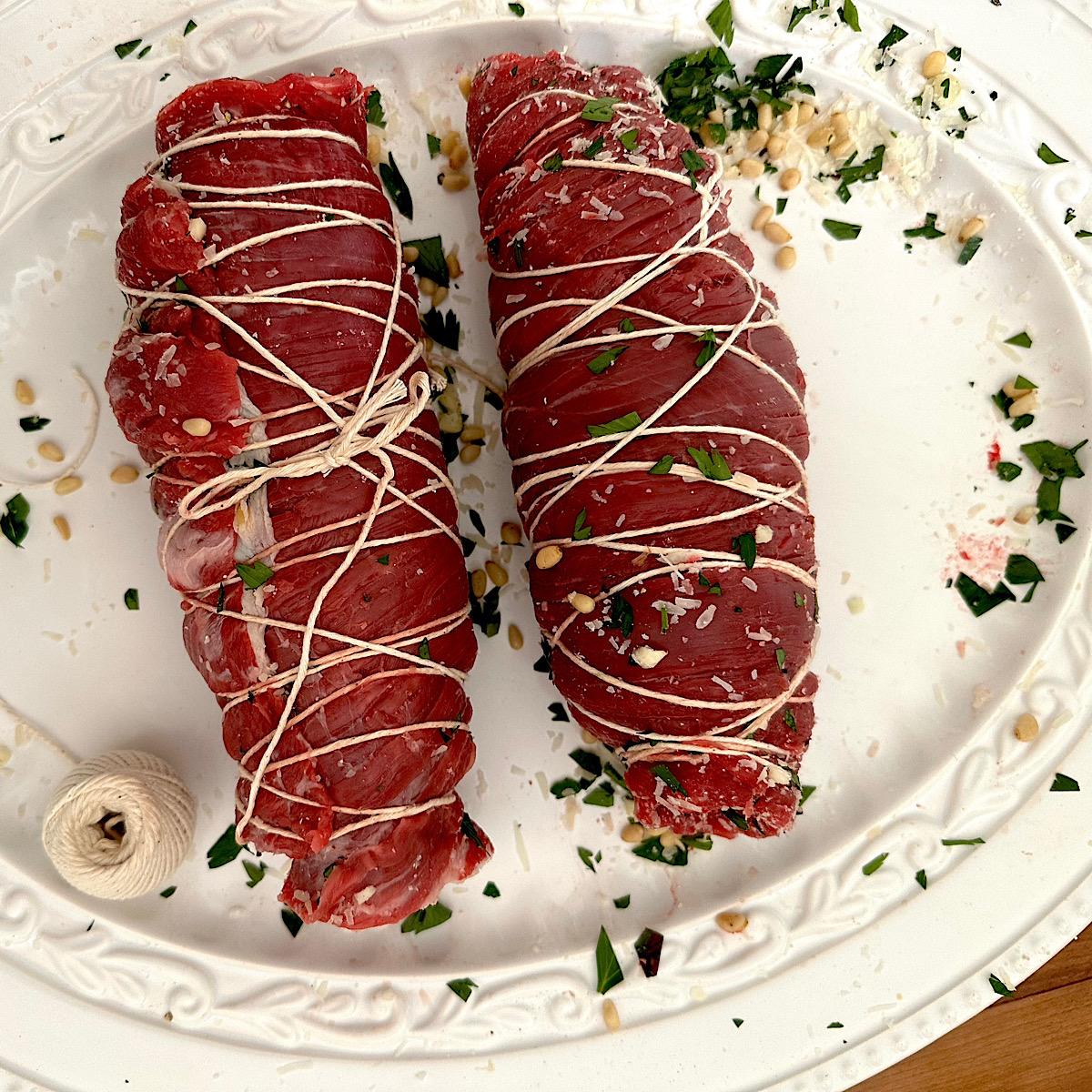
- Now roll the steaks into a roulade (like a jelly roll) starting at the skinniest end, making sure the filling is gently pushed inside the meat as it is rolled.Tie the roulade together fairly tightly with twine, making sure the ends are secured also. This step is the same for both a large single flank steak log, or several small thin top round mini logs.
- In a Dutch oven or large pot, heat 2-3 tablespoons olive oil over medium-high heat and add the chopped onion. Cook for a couple of minutes to soften (not caramelize). Once the onion is ready, add the beef roulades, raise the flame and sear on all sides until evenly browned. Add wine to deglaze. Let wine reduce by half.3 tablespoons olive oil, 1 medium onion, 1/2 cup red wine
- FOR THE TOMATO SAUCE:
- In a large bowl crush the San Marzano tomatoes with your hands. Add the hand crushed tomatoes to the pot with the braciole. Quickly add the cans of puree and tomato paste, gently stirring to meld all the tomato sauces together. Be gentle as you don't want to pull apart the tied braciole while stirring. Add the parmesan rind if using.56 ounces canned San Marzano tomatoes, 48 ounces Italian passata (tomato puree), 12 ounces tomato paste
- Bring to brief boil, then lower the heat and very slowly simmer the meat in the sauce for 2 – 3 hours. It needs to cook gently, barely bubbling. Stir gently occasionally to make sure sauce is not burning on the bottom of the pot. If you think a bit of the sauce might have burned at the bottom of the pot, DO NOT SCRAPE it please! You don't want any burned flavor getting stirred into the sauce.3 inches Parmesan Reggiano cheese rind
- About 20 minutes before the meat is done, cook the rigatoni in a pot of boiling salted water until al dente (still a little firm). Drain and place in a serving bowl16 ounces rigatoni
- Remove the meat roulades from the pot (slice into rounds if using a large flank steak, removing the twine before slicing). You can also remove the twine from the top round steak mini logs before serving if you like. Serve the braciole on a bed of the tomato sauce and pour the remaining sauce over the rigatoni.Celebrate with family and/or friends!! And don't forget a great Italian red wine!
Ok I’m biased! I grew up with my southern Italian (Triggiano/Bari) and my aunts making this for some Sundays and many celebrations. This is a perfect and fool proof recipe! My LDS in-laws (86 and 91 and not at all Italian) LOVE this dinner and I just made a triple batch for them to freeze!!
I wish I knew how to post a photo here!
This time I saved a step and used a jar of chopped garlic instead of chopping/mincing my own.
I also did something new with the beef. I got a giant package of very thinly sliced beef at Costco (I think intended for Shabu Shabu, and used 2 thin slices together for each braciole. They are so cute this little bracioles!
Oh, you have to send a photo of the little bracioles! I’d love to see!