
Quick Summary: Use a wide pot with drainage holes, at least 20 inches across (a 20-gallon pot or larger) for a mature plant, filled with half peat moss and half potting soil. Half-high varieties like Polaris, Northland, and Chippewa, or dwarf patio varieties like Top Hat, stay 1 to 3 feet tall. Give them 6 or more hours of sun and water often in summer. Potted blueberry bushes live 10 to 15 years or more with repotting and winter protection; in the ground they produce for 20 to 30 years. Read time: 10 min | Experience level: Beginner to intermediate
Jump to: Pot Size | Best Pots | How Big They Get | Best Varieties for Pots | Patio Varieties | Protection from Birds | Soil, Sun and Water | When They Fruit | How Long They Live? | Overwintering | FAQ

I grow 600 blueberry plants in the field at Heathglen Farm for selling at the farmers’ market, but I also keep several varieties in pots on my deck. Growing blueberries in containers has real advantages:
- you can quickly move them if a hailstorm or severe weather is imminent
- the deer and rabbits will not eat them if they are on a deck or balcony
- they are easy to transplant outside if your garden location changes
- it is easier to keep them free of weeds and grass
- it is easier to prevent bird damage if the pots are close to your house
The keys to success are pot size (wide, not deep), acidic soil (peat and potting mix), and choosing the right varieties for your zone. Here’s everything I’ve learned from growing blueberries in containers over 20+ years.
This post may contain affiliate links (at no cost to you). Here’s our disclosure information
What Size Pot Do Blueberries Need?
A mature blueberry bush needs a pot at least 20 inches wide and 16 to 24 inches deep, which is about a 20-gallon pot or larger. Width matters more than depth because blueberry roots are shallow. You can start a young 2-year-old plant in a 5- to 10-gallon pot and move it up as it grows.
A “highbush” blueberry will grow 6 to 8 feet tall with a 4 to 6 foot spread. The width is considered the drip line.
Blueberries have fairly shallow roots so while a fairly wide pot is required, it does not have to be extremely deep. Consider the drip line and get a wide container (at least 20″) for the roots to spread out. The height of the pot should be around 24 inches.
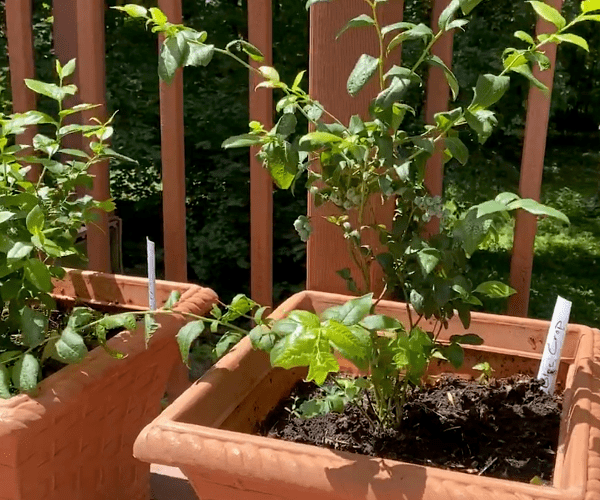
**Tip: Blueberries are really pretty in pots, but even more so when given a frill of something else beneath. Try underplanting them with some violet-flowered wood violets to amplify the beauty even more.
What Is the Best Pot for a Blueberry Bush?
The best pot for a blueberry bush is wide, light-colored, and has several drainage holes, at least 20 inches across for a mature plant. Here is how the common choices compare:
- Plastic or resin: light, inexpensive, and holds moisture. Choose a light color, because black pots get hot enough in full sun to damage shallow roots.
- Fabric grow bags: great drainage and airflow, but they dry out fast and need more watering.
- Glazed ceramic: holds moisture well, but it’s heavy and can crack if left outside in a freeze.
- Terra cotta: dries out fastest and cracks in freezes, so skip it for blueberries.
- Wood half barrels: roomy and insulating, good for a permanent spot in milder zones.
In cold climates where you move pots into a garage for winter, pick a pot you can move. A decent plant caddy with wheels makes a 20-gallon pot manageable.
How Big Do Blueberry Bushes Get in Pots?
In a pot, half-high blueberry bushes grow about 2 to 3 feet tall and wide, and dwarf patio varieties stay 1 to 2 feet. In the ground, half-highs reach 2 to 4 feet tall and about 3 feet wide, while highbush varieties grow 6 to 8 feet tall and 4 to 6 feet wide, which is too big for most pots. That’s why I grow my highbush (mostly Bluecrop, with some Elliott for a late crop) in the field and keep half-highs in pots.
What Blueberry Varieties Grow Best in Pots?
Half-high varieties like Polaris, Northland, and Chippewa grow best in pots because they stay about 3 feet tall and are hardy to zone 3.
My favorite nursery for ordering blueberry plants is De Grandchamps Farm in Michigan. I have been growing plants from them since 1998 (I currently have 600 plants) and they are the best, offering healthy plants and information on the best plant for your zone.
When you grow blueberries in pots, you can be a bit more flexible in varieties since you can easily move them, protect them from deer, and move them inside in the winter.
While you could grow high bush blueberries in pots, consider their height (7 to 8 feet) and spread (3-5 feet) at maturity and decide if you really want to grow that tall of a plant in a huge pot.
You can get a very good harvest with half high varieties grown in pots that only grow to about 3 feet tall. Check out this list of half-high varieties and their growth characteristics.
Some of the popular half high varieties that grow well in pots include North Blue, Polaris, Chippewa and Northland.
Lastly, you will get many more berries if you grow two different varieties (even if one says it is self pollinated). The bees will cross-pollinate the plants and result in a far larger harvest.
I like to get an early variety (Polaris), a mid-season variety (Northland) and a late variety (Chippewa) to extend the harvest as long as possible.
Do some research to select the best variety for your climate and growing conditions. Your local extension service is a good place to ask these questions if the chart in the above link doesn’t answer your specific questions.
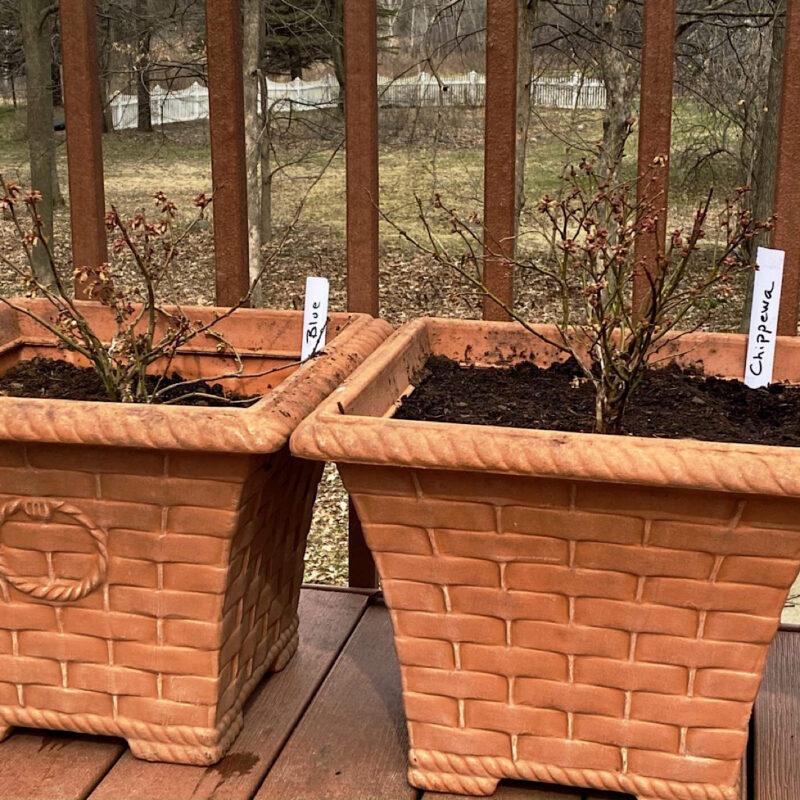
Note: In Minnesota, the blueberry harvest typically begins in mid-July and extends to mid-to-late August (with the right varieties)
Best Patio Blueberry Bushes for Small Spaces
The best patio blueberry bushes are half-highs and dwarf varieties that stay 1 to 3 feet tall, so they fit a deck, patio, or balcony pot and still produce. My patio pots hold half-highs, but for even smaller pots, nurseries sell dwarf varieties bred for containers:
- Top Hat: 1 to 2 feet tall, zones 3 to 7, bred for containers. It’s self-pollinating but sets more fruit with a partner.
- Northsky: a University of Minnesota half-high, about 1 1/2 feet tall and very hardy (zone 3).
- Jelly Bean (Bushel and Berry): 1 to 2 feet tall and rounded, zones 4 to 8.
- Sunshine Blue: a southern highbush, 3 to 4 feet tall, for zone 6 and warmer. Not hardy enough for Minnesota.
How to Protect Potted Blueberries from Birds
The easiest way to protect potted blueberries from birds is to keep the pots close to the house, where birds visit less, and drape netting over a frame for plants farther out.
One decision you need to make if you grow blueberries in pots (or in the garden) is whether to share them with the birds or try to prevent bird damage and keep them for yourself.
Birds are voracious with blueberries and they will get them right before they ripen, leaving you with a sad crop.
If you grow blueberries close to your house on a deck or a balcony, it will be a little easier to beat the birds to the harvest.
If you grow them in pots away from your daily sight line, you may need to to protect plants from the birds with bird netting raised over the plants.
Note that bird netting is very sticky and it can be a problem to just toss it over the plants, as you will pull off the berries and leaves when removing it to harvest. Better to lose some berries than all of them however, if your bird problem is severe.

Soil, Sun and Water for Blueberries in Pots
Potted blueberries need at least 6 hours of full sun, an acidic mix of about half peat moss and half potting soil (pH 4.5 to 5.5), and more frequent watering than plants in the ground.
SUN:
As with most berries and vegetables, full sun is required for a good harvest. If you grow blueberries in shady locations, they will survive but there won’t be much fruit.
Full sun is considered to be 6 hours of sun per day. Blueberries can withstand much more sun than that, but 6 hours is the minimum for a decent harvest.
With respect to climate, for zone 4 and colder, you would be best served by one of the low bush or half-high varieties.
SOIL:
There are two primary considerations when it comes to soil; acidity and drainage. Blueberries prefer an acid soil, but they also like a well-drained soil that is rich in nutrients.
Sand is well drained, but the nutrients and minerals leech out of it quickly. Clay will hold water too long and blueberries do not like to have wet feet for long.
When growing in the field, the best combination I have found is to dig a 3-foot hole and within that hole mix in 1/3 peat (for acid), 1/3 compost (for drainage), and 1/3 of your garden soil for the micronutrients.
When growing in pots, I recommend 1/2 peat and 1/2 good (but sterile) potting soil. Mix it together very, very thoroughly as water will wick off peat and not get to the roots if it is just layered into the pot.
Mulch the top of the pot with some pine needles, or wood chips to conserve soil moisture
The peat will be enough acid for the first year. After that fertilize with a fertilizer made for blueberry plants (available in all nurseries).
At some point your potted plant will benefit from repotting (every year is good). Just make sure and repot and refresh the soil before the plant is flowering to avoid transplant shock.
For keeping them acidic over time, scratch in a little elemental sulfur around the drip-line in the Fall. It will be slowly incorporated and help keep the soil acidic.
This is an organic way to help with acidity. Miracid works also, but is not organic.Avoid the temptation to over-fertilize, as it can burn their shallow roots.
WATER:
Potted blueberries dry out much faster than plants in the ground because their roots are shallow and the pot heats up in the sun. Check the mix with your finger every day in summer and water when the top inch is dry, which can mean daily watering in July. Water until it runs out the drainage holes.
If your tap water is hard, rainwater from a barrel helps keep the mix acidic.
How Long Before Blueberry Plants Produce Fruit?
A 2-year-old blueberry plant will give you a few handfuls of berries its first summer in a pot, and harvests grow each year until the plant matures at about 5 years.
Upon maturity an average harvest from a half-high variety is around 5 pints per plant (depending on variety and growing conditions)

How Long Do Blueberry Bushes Live in Pots?
Potted blueberry bushes live 10 to 15 years or more if you repot them every year or two, protect the roots in winter, and cut out old woody canes. I’ve had five varieties growing in pots for more than 8 years.
In the ground, a well-kept bush produces for 20 to 30 years or longer. The half-highs I planted at Heathglen Farm in 1998 are still producing (it’s 2026 at the time of writing).
Overwintering is where most container blueberries fail in cold climates. The roots in a container are far more exposed to freezing temperatures than roots in the ground.
In zone 4, I move my potted blueberries into an unheated garage once the plants go dormant in late fall. They can’t survive the repeated freeze-thaw cycles that happen above ground in a Minnesota winter and pots do not give them the same insulation as if they were growing in the ground. Move them back outside in early spring once temperatures are consistently above freezing at night.
Common reasons blueberries grown in pots die young are:
- the soil pH drifting above 5.5 (the leaves will yellow),
- pots that are too small for the root system,
- winter kill from leaving containers outdoors in cold climates without protection.
Address those three things and there’s no reason a potted blueberry can’t produce for you for decades.
They are woody plants and it will help to remove the old really woody canes as they mature, as that will encourage new fruiting canes that sprout from the roots. Do this before they bloom however, as bees need to pollinate the blooms in order to get fruit.
How Do You Overwinter Potted Blueberries?
In zone 4 and colder, the safest way to overwinter potted blueberries is to move them into an unheated garage once they go dormant in late fall and water them two or three times over the winter.
Winter cold can be the limiting factor when growing blueberries in containers. They do not like having their root systems completely frozen and that is likely when grown above ground in a pot in a cold climate.

I have a post that explains several methods to protect your potted blueberry plants in cold Winter climates, from burying them in the ground, to keeping them in a cool garage with some precautions. The article explains how to overwinter blueberry plants both indoors and outdoors.
All of the varieties I have tested survive our Minnesota winters in the garage. The trickiest part is moving them back outside while they are still dormant. Sometimes they will bloom in the garage before the weather stabilizes outdoors and that is a problem due to lack of bees and other blooming plants to pollinate. Just keep an eye on the weather and try and move them outside while they are still dormant.
This article on how to overwinter potted plants is more detailed and covers overwintering potted plants in general, rather than just blueberries.
FAQ
A mature blueberry bush needs a pot at least 20 inches wide and 16 to 24 inches deep, about a 20-gallon pot or larger. Width matters more than depth because the roots are shallow. Half-high and dwarf varieties suit containers best.
Yes, for a good harvest. Even self-pollinating varieties produce significantly more berries when cross-pollinated with a different variety. Plant at least two, ideally three (early, mid, and late season) to extend your harvest.
Half peat moss (for acidity) and half quality potting soil. Mix thoroughly; water wicks off layered peat. Mulch with pine needles or wood chips. Add elemental sulfur in fall to maintain acidity over time.
In cold climates (Zone 4-5), move pots to an unheated garage in late fall. Water 2-3 times over winter; blueberries can’t dry out completely. Make sure pots have drainage holes to prevent ice buildup.
Potted blueberry bushes live 10 to 15 years or more with repotting every year or two, winter protection, and removal of old woody canes. In the ground they produce for 20 to 30 years or longer. My field plants are 28 years old and still producing (as of 2026).
A 2-year-old plant produces a few handfuls the first year. Yields increase annually until maturity at 5 years, when you can expect about 5 pints per plant depending on variety and conditions.
Yes, for a year or two. A 5-gallon bucket works for a young 1- or 2-year-old plant if you drill drainage holes in the bottom, but a full-size half-high will need a 20-inch-wide pot by its third or fourth year. Dwarf varieties like Top Hat can stay in a 12- to 18-inch pot longer.
In the ground, if your soil can be made acidic. In-ground bushes live longer, yield more, and need less watering and no winter moving. Pots are the better choice when your soil is alkaline or heavy clay, when you rent, or when you only have a deck or patio, because you control the acidic mix completely.
Check out this collection of over 80 blueberry recipes, developed and tested from our farm (Heathglen Farm). Available in pdf form as a digital ebook ($14.95), or as a print book from Amazon (paperback or hardcover).

Thank you for the great post! I also live in MN. I have some acreage that I’ve planted blueberries on (this year). So far, so good. Do you grow any high bush varieties? If so, do you find they grow well in our MN climate?
Hi Andrew, Yes I do grow some high bush. I started with all half-highs, but that was in 1998 and our climate has changed since then. I planted about 50 high bush varieties about 5-6 years ago and they are doing really well. Mostly it was Bluecrop with a few Elliots for some late varieties. They do great. I’m sure our micro-climates are a bit different, but probably not to any significant degree. Go for it!!
Thank you so much! Do you use elemental sulfur to bring down pH? I added quite a bit of peat moss like you said when I planted this spring. Do you have a recommended way to test soil pH?
Yes, I do use elemental sulphur, not every year, but some. Just sprinkle it around under the plant in the fall and let it work its way into the soil (you can scratch it in a bit, but no need to dig). Re testing the soil. The extension service gives you free sampling bags and then you send it in to their lab. I haven’t done it for a long time, but it used to be pretty cheap.
This is great information. Thank you for sharing!